
NYC Commercial Real Estate in 2026: Best Places to Open Your Business
New York City’s commercial real estate market is evolving rapidly in 2026. From Manhattan office spaces to Brooklyn startup hubs and high traffic retail districts, discover where entrepreneurs and business owners should open their next business for maximum visibility, growth, and long term success.

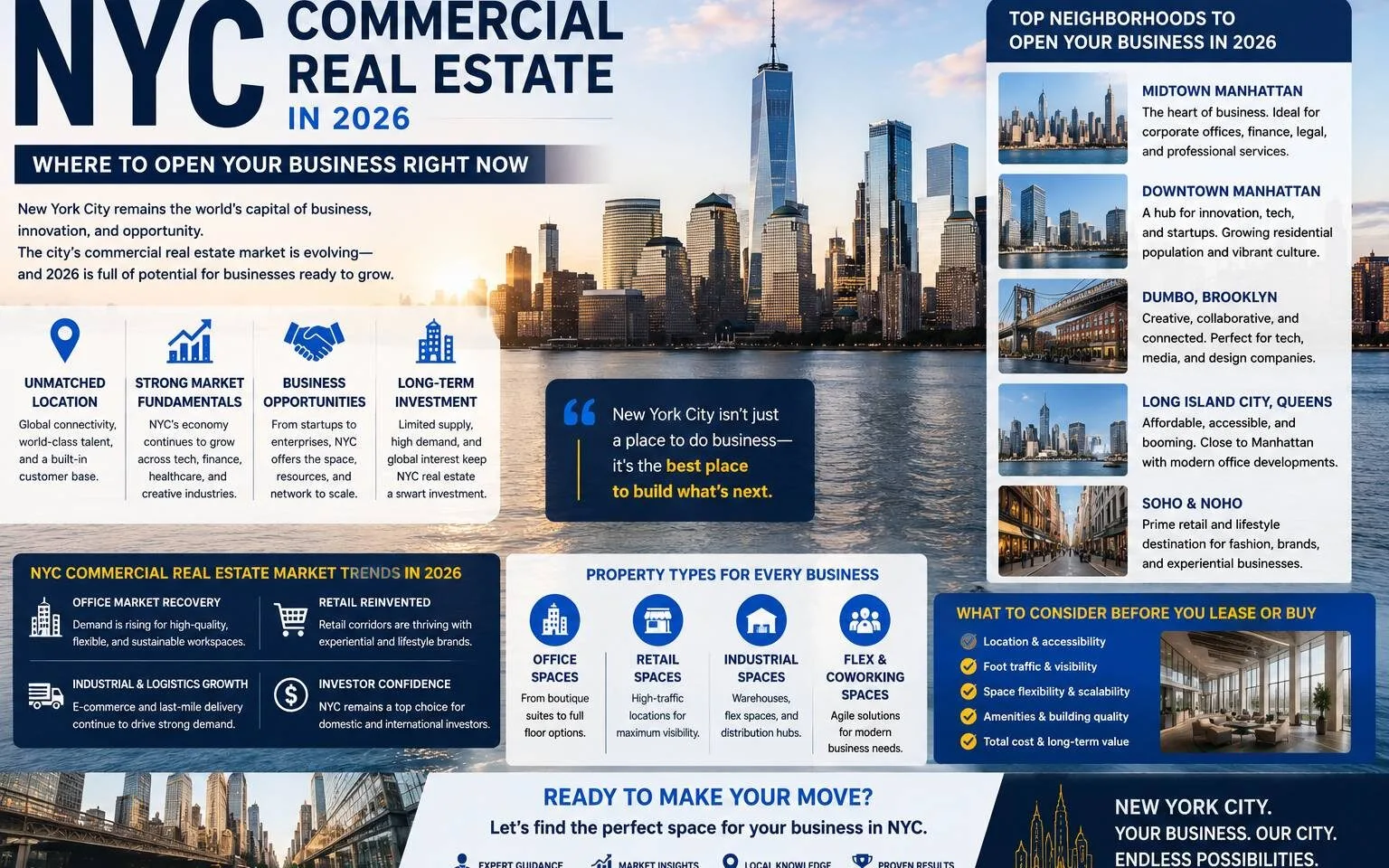
If you have been thinking about opening a new location, expanding your existing business, or finally making the leap from working out of your apartment to having a real commercial space, you have picked a genuinely interesting moment to be making that decision. New York City’s commercial real estate market in 2026 looks nothing like it did five years ago, and the gap between the neighborhoods that are thriving and the ones that are struggling creates a landscape of opportunity that is unlike anything this city has seen in a generation.
The old rules about where to open a business in New York City are being rewritten in real time. Neighborhoods that were considered too expensive for small businesses two years ago now have landlords offering concessions that would have been unthinkable in 2019. Areas that were overlooked or written off are experiencing genuine revivals driven by demographic shifts, new transportation infrastructure, and the migration of residents who followed remote work flexibility to parts of the city where they could actually afford to live and breathe. And some of the most storied commercial corridors in the city are still struggling with vacancy rates that tell a painful story about the distance between where the market was and where it is today.
This guide is built for New York City business owners who are making real decisions about real space in the real market that exists right now. We are going to cover the neighborhoods where the opportunity is greatest, the market dynamics that are shaping those opportunities, the questions you need to ask before you sign any lease, and the strategic framework that should guide every location decision you make in 2026.
The State of the Market: What 2026 Actually Looks Like
Before we get into the neighborhood by neighborhood analysis, it is worth establishing a clear picture of the overall market dynamics that are shaping commercial real estate across all five boroughs in 2026. The macro conditions are the water every business owner is swimming in, and understanding them is essential to making smart micro decisions about specific neighborhoods and spaces.
Office Space: The Bifurcation Is Complete
The great debate about whether New York City office workers would return to their desks has been substantially resolved, and the resolution has produced a deeply bifurcated market. Class A office space, meaning the newest, best-located, most amenity-rich buildings, has recovered strongly. Major corporations, financial institutions, and law firms have demonstrated a clear preference for high-quality space and have been willing to pay premium rents to consolidate their footprints into buildings that can attract employees who have been spoiled by the comfort of working from home.
The result for Class A space in prime locations like Hudson Yards, the Plaza District in Midtown, and the newer trophy towers in Lower Manhattan is a market that is tight, competitive, and expensive. If you are looking for premium office space in the best buildings in the most desirable locations, you will find that the landlord has more leverage than at any point in the past four years.
Class B and Class C office space tells an entirely different story. Older buildings, particularly those built before 2000 without significant recent renovation, in secondary Midtown locations or in neighborhoods that have not benefited from the flight-to-quality dynamic, are struggling with vacancy rates that in some cases exceed thirty percent. Landlords in this segment of the market are under significant financial pressure, which creates negotiating leverage for tenants that is genuinely extraordinary by historical standards.
For small and medium-sized businesses that do not need a prestigious address and are prioritizing value over image, the Class B office market in 2026 offers opportunities to secure high-quality space at rents and on lease terms that represent the best value proposition in decades.
Retail: The Street Level Renaissance Is Real, But Selective
The story in retail real estate is more nuanced and ultimately more optimistic than many predicted during the darkest days of the pandemic. Street-level retail has not died in New York City. It has transformed, and in many neighborhoods it is genuinely thriving. But the transformation is uneven, and the difference between a retail corridor that is working and one that is not is sharper than at any previous point in the city’s commercial history.
The retail corridors that are winning in 2026 share several characteristics. They serve dense residential populations with genuine daily needs. They have benefited from the shift of foot traffic away from major office corridors toward neighborhood streets where residents actually spend their time. They have attracted the kinds of tenants that create destination shopping or dining experiences, drawing customers from beyond the immediate neighborhood. And they have landlords who have been pragmatic about rents and tenant mix, accepting below-peak rents in order to fill spaces with viable businesses that anchor the corridor.
The corridors that are still struggling are primarily those that were built around office worker foot traffic that has not fully returned, tourist-dependent strips that have been slow to recover international visitor volumes, and locations where landlords have held out for pre-pandemic rents and accumulated long-term vacancies as a result.
Industrial and Flex Space: The Hottest Sector in the Market
If there is one segment of the New York City commercial real estate market that is unambiguously strong across all five boroughs, it is industrial and flex space. The explosion of e-commerce, last-mile delivery logistics, food production and commissary kitchens, life sciences research, and creative production uses has driven demand for industrial space that far outstrips supply in many parts of the city.
Industrial vacancy rates in the outer boroughs, particularly in the Bronx, Queens, and Brooklyn, are at historically low levels, and rents have risen substantially even as office rents were collapsing. If your business has any kind of production, storage, distribution, or workshop component, you are operating in a tight market where early movers have a significant advantage.
The Concessions Environment: Never Been Better for Tenants
One of the most important market dynamics for business owners to understand in 2026 is the concessions environment. Even in submarkets where asking rents have stabilized or recovered, landlords across virtually all property types and neighborhoods are offering concessions that significantly reduce the effective cost of occupancy for tenants who know how to negotiate.
Free rent periods of three to six months on five year leases are common. Tenant improvement allowances, money the landlord contributes to building out your space, are at historically high levels as landlords compete for creditworthy tenants. Flexible lease structures, including shorter initial terms with renewal options, are more available than they have been in decades. And landlords who previously would not entertain revenue-sharing or percentage rent arrangements are now open to creative deal structures that reduce a tenant’s fixed cost burden in the early years of a lease.
The business owners who are winning in the current leasing environment are those who approach lease negotiations with the same sophistication and preparation that they bring to any major business decision, which means understanding the market, understanding the landlord’s situation, and being willing to ask for terms that they might have assumed were unavailable.
Manhattan: Where the Opportunity Lives in 2026
Manhattan’s commercial real estate market in 2026 is a city of contrasts, with some of the most expensive and competitive space in the world sitting within walking distance of corridors where landlords are genuinely desperate to fill vacant storefronts. Knowing which is which is the foundation of making a smart location decision.
Lower Manhattan and the Financial District: The Residential Conversion Story
Lower Manhattan has undergone a transformation over the past decade that is continuing to reshape its commercial landscape in ways that create interesting opportunities for the right kinds of businesses. The conversion of formerly vacant office towers into residential units, a trend that accelerated significantly after the pandemic and has continued with strong support from the city government, has dramatically increased the residential population in the Financial District and surrounding neighborhoods.
This residential influx has changed the nature of the retail and service demand in Lower Manhattan in a fundamental way. The area that was once almost exclusively a nine to five business district is now a genuine mixed-use neighborhood with residents who need grocery stores, dry cleaners, fitness studios, family restaurants, healthcare providers, and all the other services that support daily residential life. Businesses that cater to this residential population rather than to the office worker foot traffic of the past are finding a growing and underserved customer base.
Retail rents in the Financial District remain well below their pre-pandemic peaks, which means the combination of growing residential foot traffic and attractive lease economics makes this one of the more compelling opportunities in Manhattan for businesses oriented toward neighborhood services and dining.
The continued development of the Seaport District, with its mix of dining, entertainment, and experiential retail, has added a destination dimension to the Lower Manhattan market that draws visitors from across the city and beyond, creating additional foot traffic opportunities for businesses located in or near the Seaport corridor.
Midtown South and the Flatiron District: Still the Heart of NYC Business
The Midtown South corridor, anchored by the Flatiron District and extending through Chelsea, the Garment District, and into Hudson Square, remains one of the most dynamic commercial real estate markets in the city. The concentration of technology companies, creative agencies, professional services firms, and fast-growing startups in this zone has created a commercial ecosystem that is remarkably resilient and continues to attract new businesses at a steady pace.
Office rents in this submarket are not cheap, particularly in the most desirable buildings near Madison Square Park and along Broadway in the Flatiron District. But the value proposition is real: the density of potential corporate clients, the quality of the talent pool, and the brand associations of a Flatiron or Chelsea address have genuine business value for companies in professional services, technology, creative, and consulting fields.
For retail and food and beverage businesses, the Midtown South corridor offers a blend of daytime office worker traffic and evening residential and visitor traffic that supports a wide range of business models. The explosion of residential development along the West Side in Hudson Yards and Hell’s Kitchen has added a significant residential customer base to a corridor that was previously more dependent on daytime office traffic.
Specific streets and blocks within this corridor vary significantly in terms of rent, foot traffic, and competitive dynamics. Doing your homework on the specific block rather than just the neighborhood is essential, as conditions can change dramatically within a few hundred feet in this part of Manhattan.
Hudson Yards: Premium Space for Premium Businesses
Hudson Yards is a genuine anomaly in the 2026 Manhattan commercial real estate market: a submarket where demand has remained strong, rents are at or near their peaks, and the landlord has more leverage than in virtually any other part of the city. The combination of brand-new Class A office space, high-end retail, luxury residential, and excellent transportation infrastructure has created a self-reinforcing ecosystem that has proven more resilient than most market watchers expected when the development launched.
For businesses that need premium office space, particularly those in financial services, consulting, technology, and other fields where the quality of the physical environment is a meaningful factor in recruiting and client relationships, Hudson Yards is worth the premium. For businesses that do not need or cannot justify that premium, there are better value propositions elsewhere in the market.
The retail environment at Hudson Yards, anchored by the Shops at Hudson Yards, is expensive and heavily oriented toward luxury and premium brands. It is not the right environment for most small and independent businesses, but for businesses in the premium lifestyle, wellness, and professional services categories, the demographics of the Hudson Yards visitor and resident population are extremely attractive.
Harlem and Upper Manhattan: The Long-Awaited Moment
Upper Manhattan, and Harlem in particular, has been described as the next frontier of New York City commercial real estate for so long that the phrase has become almost a cliche. But in 2026, there are genuine reasons to believe that the moment for Upper Manhattan commercial real estate has arrived in a way that earlier cycles of enthusiasm did not fully deliver on.
The residential population in Harlem and Washington Heights has grown significantly over the past decade, and the income demographics of that population have shifted in ways that support a broader range of commercial businesses. The concentration of Columbia University’s expanding footprint, including its Manhattanville campus, is creating a consistent anchor of institutional demand and educated consumers. And the commercial rent levels in Harlem remain dramatically lower than in Midtown or Lower Manhattan, which means the rent-to-foot-traffic ratio can be highly favorable for businesses that serve the local population.
125th Street, the main commercial artery of Harlem, has seen significant investment in recent years and supports a growing mix of national retailers and local businesses. But the more interesting opportunities for independent businesses may be on the side streets and secondary corridors that serve the dense residential population of the surrounding blocks without the higher rents that 125th Street commands.
Washington Heights and Inwood, further north, represent some of the most undervalued commercial real estate in Manhattan relative to the density and loyalty of the surrounding residential customer base. These neighborhoods have strong, community-oriented consumer cultures that tend to support local businesses with genuine enthusiasm, and the commercial rents reflect a market that has not yet been discovered by the broader investment community.
Brooklyn: The Borough That Rewrote the Rules
Brooklyn’s commercial real estate story in 2026 is one of the most complex and interesting in the entire city, because the borough encompasses everything from some of the most expensive retail corridors in New York to some of the most affordable and opportunity-rich industrial zones on the East Coast. Understanding Brooklyn’s geography is essential to making smart decisions about commercial space in the borough.
DUMBO and the Brooklyn Tech Triangle: Premium for Premium Businesses
DUMBO, long established as Brooklyn’s premier technology and creative business district, continues to command premium rents that reflect both its exceptional quality of life and its concentration of high-value tenants. The neighborhood’s combination of converted warehouse loft spaces, waterfront views, easy Manhattan access via multiple subway lines and the East River Ferry, and a vibrant street-level ecosystem of restaurants and galleries makes it one of the most desirable addresses for creative, technology, and media businesses in the entire city.
Office rents in DUMBO are not cheap by Brooklyn standards, though they remain meaningfully below comparable Manhattan locations. For businesses that value the brand identity and talent-recruiting advantages of a DUMBO address, the premium is often justifiable. For businesses that are primarily focused on cost efficiency, the premium is harder to rationalize when comparable-quality space is available in neighboring Brooklyn neighborhoods at significantly lower rates.
The broader Brooklyn Tech Triangle, encompassing DUMBO, Downtown Brooklyn, and the Brooklyn Navy Yard, represents a genuine commercial ecosystem with critical mass of technology and creative businesses, supporting services, and institutional anchors like Pratt Institute and the growing Life Sciences cluster at the Navy Yard.
Downtown Brooklyn: The Value Play Right Next Door
Downtown Brooklyn is one of the most compelling commercial real estate stories in New York City in 2026. The neighborhood has benefited from enormous residential development that has added tens of thousands of new residents over the past decade, a growing roster of office tenants who have migrated from Manhattan seeking better value, and continued investment in public infrastructure that has made the neighborhood more accessible and livable.
Office rents in Downtown Brooklyn offer genuine value relative to Manhattan, particularly in the newer office towers that have been built or significantly renovated in recent years. The submarket has attracted a growing number of technology, media, and professional services tenants who have made the calculation that the cost savings relative to Manhattan are worth the slightly different address.
The retail market along Fulton Street and in the Atlantic Terminal area is one of the highest-foot-traffic retail environments in the outer boroughs, supported by the extraordinary concentration of subway and Long Island Rail Road access at Atlantic Terminal. Rents on the primary retail corridors reflect this foot traffic and can be competitive with secondary Manhattan locations, but the residential density and transit infrastructure make the customer volume genuinely comparable to many Manhattan corridors.
Bushwick and East Williamsburg: Industrial Opportunity in a Creative Zone
Bushwick has completed the transition from overlooked industrial neighborhood to established creative and cultural district, and its commercial real estate market reflects that transformation while still offering opportunities that are not available in the more expensive neighborhoods to the west. The neighborhood’s concentration of artists, musicians, independent retailers, food businesses, and creative professionals creates a consumer culture that is unusually supportive of independent businesses that fit the neighborhood’s aesthetic.
Retail rents in Bushwick remain accessible relative to Williamsburg proper, and the industrial and flex space that lines the neighborhood’s manufacturing corridors has become highly sought after for production uses, commissary kitchens, studios, and maker businesses. The neighborhood’s position at the intersection of the L and J/M/Z subway lines provides solid transit access that supports both employee commuting and customer traffic.
East Williamsburg, the transitional zone between Williamsburg and Bushwick, offers some of the most interesting industrial and flex space opportunities in Brooklyn, with a mix of legacy manufacturing buildings and newer light industrial developments that cater to the food production, creative production, and logistics businesses that have found the area’s combination of space, location, and relative affordability to be compelling.
Crown Heights, Flatbush, and Central Brooklyn: The Residential Density Play
The neighborhoods of Central Brooklyn, including Crown Heights, Flatbush, Prospect Lefferts Gardens, and Ditmas Park, represent one of the most underappreciated commercial real estate opportunities in New York City. The residential population of these neighborhoods is dense, diverse, economically mixed, and underserved by the kinds of businesses that have proliferated in the more heavily gentrified neighborhoods to the north and west.
Commercial rents in Central Brooklyn are among the most affordable in the borough, and the gap between those rents and the purchasing power of the surrounding residential population has created significant opportunities for businesses that understand and serve the local community. The caveat is that success in these neighborhoods requires genuine engagement with and understanding of the local consumer culture, which is not monolithic but is deeply rooted in the specific demographic and cultural character of each neighborhood.
The Nostrand Avenue and Flatbush Avenue commercial corridors are the primary retail arteries of Central Brooklyn, with high foot traffic and a mix of established neighborhood businesses and newer entrants that are discovering the combination of affordable rents and loyal residential customer bases. For businesses in food and beverage, personal services, health and wellness, and community-oriented retail, these corridors offer some of the best economics in the city.
Sunset Park and Industry City: Brooklyn’s Industrial Powerhouse
Sunset Park has emerged as one of the most dynamic industrial and mixed-use commercial neighborhoods in New York City, anchored by Industry City, the six-million-square-foot former maritime industrial complex on the Brooklyn waterfront that has been transformed into one of the most innovative commercial campuses in the country.
Industry City hosts a remarkable mix of manufacturing, food production, creative businesses, retail, and office tenants in a physical environment that is genuinely unlike anything else in New York City. For businesses in food production, artisan manufacturing, design, technology, and creative fields, Industry City offers space configurations and a business community that are extremely difficult to replicate elsewhere.
The surrounding Sunset Park neighborhood has a large and economically active immigrant population, primarily Chinese American and Latino, that supports a vibrant local commercial ecosystem along Fifth Avenue and elsewhere. Commercial rents in the neighborhood are among the most affordable in Brooklyn, and the combination of a loyal local customer base and improving transit connectivity makes Sunset Park an increasingly attractive location for businesses willing to engage authentically with the local community.
Queens: The Outer Borough That Is Ready for Its Moment
Queens has long been New York City’s most diverse borough and one of its most economically dynamic, but it has historically been overlooked by the commercial real estate investment community that has focused on Manhattan and Brooklyn. In 2026, Queens is increasingly difficult to ignore, and the business owners who are paying attention are finding opportunities that simply do not exist in more heavily competed markets.
Long Island City: The Value Alternative to Manhattan
Long Island City’s proximity to Midtown Manhattan, accessible via a single stop on the E, M, and 7 trains, has made it one of the most logical and compelling alternatives to Manhattan office space for businesses that need to be in the New York metro core but are not willing to pay Manhattan rents. The submarket has a growing stock of Class A and B office space, a rapidly expanding residential population, and a commercial infrastructure that has been significantly upgraded over the past decade.
The Amazon HQ2 saga, as discussed in our previous analysis of the NYC tech ecosystem, brought enormous attention and subsequent investment to Long Island City even after Amazon’s withdrawal, and the neighborhood has benefited from that investment cycle in terms of infrastructure, amenities, and the general quality of the built environment. For businesses in technology, media, creative, and professional services that want Class A space at a meaningful discount to Manhattan, Long Island City remains one of the most compelling propositions in the market.
The industrial waterfront along the East River in Long Island City also hosts a growing cluster of creative and production businesses in the former industrial buildings that have been adapted for contemporary commercial uses. Film and television production, food manufacturing, art studios, and design businesses have all found Long Island City’s combination of space, light, and location to be highly attractive.
Astoria and Jackson Heights: Queens’ Commercial Powerhouses
Astoria remains one of the most commercially vibrant neighborhoods in Queens, with a diverse mix of retail, restaurant, and service businesses along Steinway Street, Ditmars Boulevard, and 31st Street that serve one of the most ethnically diverse residential populations in the world. Commercial rents in Astoria are affordable relative to Manhattan and even much of Brooklyn, and the residential density and purchasing power of the surrounding population is genuinely strong.
For businesses in food and beverage, personal services, healthcare, and neighborhood retail, Astoria represents an excellent combination of affordable rents, accessible transit, and a loyal and growing residential customer base. The neighborhood has attracted a significant influx of younger residents over the past decade, adding a demographic layer of younger professional consumers to the established community of longtime Greek American, Middle Eastern, and South Asian residents.
Jackson Heights, the extraordinarily diverse neighborhood in central Queens served by the 7 train and the E, F, M, and R trains at Roosevelt Avenue, is one of the most vibrant commercial districts in the outer boroughs. The concentration of South Asian, Latin American, Tibetan, and dozens of other immigrant communities has created a commercial ecosystem of remarkable richness and variety, with retail rents that are among the most affordable of any high-foot-traffic commercial corridor in the city.
For businesses that serve the specific communities of Jackson Heights, or that want to participate in a commercial district defined by authentic cultural richness rather than homogenized commercial chains, this neighborhood offers opportunities that are genuinely unique in the New York City market.
Flushing: The Second Downtown
Flushing has grown into one of the most economically powerful commercial districts in the outer boroughs, with a density of retail, restaurant, and service businesses along Main Street and in the surrounding blocks that rivals many Manhattan commercial corridors in terms of foot traffic and sales volume. The neighborhood serves as the commercial hub for the enormous Chinese American community of Queens and attracts customers from across the metropolitan area for its extraordinary concentration of authentic Asian cuisine, retail, and services.
Commercial rents in Flushing, particularly on Main Street, have risen significantly over the past decade as the neighborhood’s commercial success has become widely recognized and demand from both Chinese American businesses and outside investors has increased. The secondary streets and blocks around the Main Street corridor offer better value for businesses that can draw customers from the surrounding residential population without requiring the premium foot traffic location.
The continued development of Flushing Yards, a massive mixed-use development project that will add significant commercial space, residential units, and a hotel to the waterfront area near Citi Field, is expected to further accelerate the commercial development of the broader Flushing submarket over the coming years.
Jamaica and Southeast Queens: The Frontier Opportunity
Jamaica, the commercial hub of Southeast Queens, has been the subject of significant public and private investment over the past several years, and the results are beginning to be visible in the commercial real estate market. The neighborhood’s extraordinary transit connectivity, serving as the terminus of the AirTrain to JFK Airport, the Long Island Rail Road, and multiple subway lines, creates a level of regional accessibility that few outer borough neighborhoods can match.
Commercial rents in Jamaica are among the most affordable in Queens despite this transit connectivity, reflecting a market that has been underinvested and undervalued relative to its structural advantages. For businesses in logistics, travel services, professional services, and neighborhood retail, Jamaica’s combination of transit access, affordable rents, and a large and underserved residential population creates a compelling opportunity for early movers.
The Bronx: New York’s Most Undervalued Commercial Borough
The Bronx has been called the most undervalued commercial real estate market in New York City for many years, and in 2026 that characterization remains accurate even as the borough has seen meaningful commercial development activity in several key corridors. For business owners willing to look beyond the established commercial districts of Manhattan and Brooklyn, the Bronx offers opportunities that are simply not available elsewhere in the city.
The South Bronx Industrial Corridor: A National Leader in Urban Manufacturing
The South Bronx has emerged as one of the most important urban manufacturing and industrial districts on the East Coast, with a concentration of food production, logistics, construction trades, and light manufacturing businesses that has been actively supported by city economic development initiatives. Industrial rents in the South Bronx remain among the lowest in the five boroughs despite strong demand from logistics and last-mile delivery operators, food producers, and creative industrial businesses.
The Hunts Point neighborhood, home to the nation’s largest food distribution center, represents a unique commercial ecosystem built around food production and distribution. For businesses in food manufacturing, food service supply, and related industries, Hunts Point offers a concentration of suppliers, buyers, infrastructure, and workforce that creates network effects that are difficult to replicate anywhere else in the metropolitan area.
Fordham Road and the Grand Concourse: High Foot Traffic at Affordable Rents
Fordham Road in the central Bronx is one of the highest foot traffic retail corridors in New York City, serving a dense residential population with strong daily needs for retail, food, and services. Commercial rents on Fordham Road are a fraction of what comparable foot traffic corridors command in Manhattan or even much of Brooklyn, creating a situation where the rent-to-customer ratio is genuinely exceptional for the right kinds of businesses.
The Grand Concourse, the Bronx’s primary commercial and cultural boulevard, has seen renewed investment and is developing a growing ecosystem of restaurants, cultural venues, and neighborhood services that reflects both the borough’s existing communities and the demographic changes that have accompanied new residential development along the corridor.
For businesses in neighborhood retail, food and beverage, personal services, and healthcare that are willing to build genuine community relationships in the Bronx, the combination of high residential density, strong community loyalty, and affordable rents creates one of the best economic propositions in the New York City commercial market.
Staten Island: The Borough That Rewards the Committed
Staten Island occupies a unique position in the New York City commercial real estate market. It is the borough most removed from the transit infrastructure that defines commercial dynamics in the other four boroughs, which creates both challenges and opportunities for businesses considering a Staten Island location.
The North Shore of Staten Island, centered on the St. George waterfront and the corridor along Bay Street toward Stapleton, has been the focus of significant city-supported commercial development and is home to a growing cluster of creative, technology, and food businesses that have established the area as a genuine destination for visitors from across the harbor. The St. George commercial district, accessible via the Staten Island Ferry and the Staten Island Railway, has an emerging restaurant and creative scene that is attracting increasing attention.
For businesses that serve Staten Island’s large and economically active residential population, the island’s suburban commercial strips along Victory Boulevard, Richmond Avenue, and Hylan Boulevard offer affordable rents and loyal customer bases that can support a wide range of retail, food, and service businesses. The lower commercial real estate costs relative to the rest of the city are a genuine structural advantage for businesses whose customers are primarily Staten Island residents.
The completion of the Goethals Bridge replacement and ongoing improvements to ferry service have incrementally improved Staten Island’s connectivity to the broader metropolitan area, and the borough’s relatively affordable residential costs continue to attract residents from more expensive parts of the city, gradually growing the consumer base available to local businesses.
The Questions Every Business Owner Must Ask Before Signing a Lease
Understanding the neighborhood-by-neighborhood landscape is necessary but not sufficient for making a smart commercial real estate decision. The specific terms of the lease you sign will determine whether a good location becomes a great business decision or a financially crippling one. Here are the questions every New York City business owner must get answers to before committing to any commercial space in 2026.
What Is the Effective Rent, Not Just the Asking Rent?
The asking rent posted in a listing or quoted by a broker in an initial conversation is almost never the rent you will actually pay. In the current market, the gap between asking rent and effective rent can be enormous. Free rent periods, tenant improvement allowances that offset your buildout costs, landlord contributions to furniture or equipment, and below-market rents in the first years of a lease can reduce your effective occupancy cost dramatically below the headline number.
Always negotiate aggressively on the total economic package of the lease, not just the per square foot rent. A landlord who will not move on the face rent may be willing to provide six months of free rent, a substantial TI allowance, and a cap on annual rent increases that collectively make the economics of the deal far more attractive than the face rent suggests.
What Are the Operating Expenses and Who Pays Them?
Commercial leases in New York City come in several structures, with very different implications for your total cost of occupancy. In a gross lease, the landlord pays operating expenses and you pay a single rent figure. In a net lease or one of its variations, you pay base rent plus some or all of the operating expenses including real estate taxes, insurance, and maintenance costs. Understanding exactly which expenses you are responsible for, and getting a reliable estimate of their current level and how they have changed historically, is essential to understanding your true occupancy cost.
Real estate tax escalations in particular can be a significant and often underestimated cost in commercial leases. If your lease requires you to pay your proportionate share of increases in the building’s real estate taxes above a base year, and if the city reassesses the building’s value upward after you move in, your tax obligation can increase substantially. Get a clear picture of the property’s current and projected tax burden before you sign.
What Is the Landlord’s Financial Situation?
The financial health of your landlord matters more than most business owners realize when they are evaluating a commercial space. A landlord who is under financial stress, carrying heavy debt on the property, or in default on their mortgage may not have the resources to fulfill maintenance and repair obligations, may be subject to foreclosure that could disrupt your tenancy, or may be motivated to sell the building to a new owner whose plans for the property conflict with your continued occupancy.
In the current market, with many commercial property owners carrying debt at interest rates that have significantly increased the cost of capital relative to when loans were originally taken out, and with refinancing conditions that are genuinely challenging for properties with elevated vacancies, the financial health of individual landlords varies enormously. Do your diligence on who owns the building, what their financial situation is, and what their plans for the property are before you commit to a multi-year lease.
What Are the Use Restrictions and Build-Out Requirements?
Commercial leases in New York City routinely contain use restrictions that specify exactly what activities are permitted in the space. These restrictions exist in the lease itself and are layered on top of the city’s zoning requirements, which themselves prescribe what uses are permitted by right in different locations. Understanding both layers of restriction before you sign is essential, and the implications can be significant.
A restaurant use requires specific fire suppression, ventilation, grease trap, and plumbing infrastructure that must be either present in the space or buildable within your TI budget. A retail space in a manufacturing zone may not be permissible under zoning regulations. A medical use requires ADA compliance and specific utility configurations that not every commercial space can accommodate. Verify that your intended use is both permitted by the lease and legal under the applicable zoning before you invest time, money, and emotional energy in a space that ultimately cannot work for your business.
What Are the Exit Provisions?
Every business owner signing a commercial lease should understand the scenarios under which they might need to exit the lease early and what the financial consequences of each exit scenario would be. Subletting provisions, assignment rights, early termination options, and personal guarantee provisions are all critical elements of a commercial lease that have major implications for your financial exposure if your business circumstances change.
In a market where lease terms are generally more favorable to tenants than they have been historically, pushing for subletting rights, assignment rights that facilitate a business sale, and personal guarantee burn-down provisions that reduce your personal liability over time is both reasonable and achievable. The time to negotiate these provisions is before you sign, not after your circumstances have changed and you are negotiating from a position of desperation.
Working with Brokers: What NYC Business Owners Need to Know
Navigating the New York City commercial real estate market without a broker is technically possible but practically very difficult, particularly for business owners who do not have deep familiarity with the market. Understanding how brokers work and how their incentives align or conflict with yours is essential to using brokerage relationships effectively.
Tenant representation brokers work on your behalf as the prospective tenant and are compensated by a commission paid by the landlord at lease signing. In theory, this means their services cost you nothing. In practice, it means their commission is a percentage of the total rent value of the lease, which creates an incentive structure that favors larger spaces and longer terms even when a smaller space or shorter term might better serve your interests.
The best tenant representative brokers in the New York City market have deep relationships with landlords and detailed knowledge of off-market spaces, pending vacancies, and landlord motivations that can give you significant advantages in the negotiating process. They can also provide credible market comparables that strengthen your negotiating position and identify structural problems with spaces before you invest significant time in pursuing them.
Get referrals from other business owners who have recently leased space in the neighborhoods you are targeting, interview multiple brokers before selecting one, and be explicit about your priorities and constraints from the beginning of the relationship. The more clearly a broker understands what you actually need, the more effectively they can serve you.
The Emerging Neighborhoods: Where to Watch for the Next Wave
Beyond the established commercial districts covered above, there are several neighborhoods and corridors in New York City that are in the early stages of commercial development and offer the kind of ground-floor opportunities that established districts can no longer provide.
Gowanus in Brooklyn is in the midst of a major rezoning-driven transformation, with significant residential and commercial development expected over the next several years as the neighborhood’s former industrial land is converted to mixed-use development. The timing is early enough that businesses that establish themselves in the neighborhood now can benefit from the commercial premium that will come as the development cycle matures.
Mott Haven in the Bronx, just across the bridge from East Harlem, has been attracting creative businesses, artists, and residential developers who have been priced out of Brooklyn’s established creative neighborhoods. The neighborhood has the physical infrastructure, the location, and the emerging cultural community to develop into a significant commercial district over the next five to seven years.
Far Rockaway in Queens has been the subject of significant city investment in commercial and residential development following the long-delayed completion of rezoning and infrastructure improvements. The combination of beachfront location, improving transit connections, and some of the most affordable commercial rents in the city creates an unusual opportunity for businesses oriented toward the local residential community and the seasonal beach visitor market.
The Jerome Avenue Corridor in the Bronx, subject to a major rezoning that has been slowly changing the character of this longtime auto-service industrial strip, is developing a growing residential population that is creating demand for retail and services that currently have very limited supply.
A Strategic Framework for Your 2026 Location Decision
All of the neighborhood-by-neighborhood analysis in this guide only matters insofar as it informs a sound decision-making process for your specific business and situation. Here is the strategic framework we recommend for every New York City business owner who is making a location decision in 2026.
Start with your customer first, not the real estate. The best location for your business is where your customers are or where you can most efficiently reach them, not the neighborhood with the most interesting commercial real estate story. Define your target customer precisely, understand where they live, work, and spend time, and let that analysis drive your neighborhood selection before you look at a single listing.
Then stress-test your unit economics at several different rent levels before you fall in love with any specific space. Model out your revenue and profitability assumptions at the asking rent, at a negotiated rent you believe you can achieve, and at a worst-case scenario where you pay full asking rent and your business takes longer than expected to reach projected revenue levels. If the numbers do not work in the stress-test scenario, the space is wrong for your business regardless of how appealing it is.
Next, spend time in the neighborhood before you commit. Visit at different times of day and different days of the week. Talk to other business owners in the area about foot traffic patterns, seasonality, the landlord’s responsiveness, and the general business environment. The intelligence you can gather from five conversations with neighboring business owners is often more valuable than anything a broker or a market report can tell you.
Finally, negotiate as if the deal might fall apart. In the current market, tenants have more leverage than at any point in recent memory in many submarkets, but that leverage evaporates if the landlord believes you are emotionally committed to a specific space and will sign regardless of the terms. Approach every lease negotiation with genuine willingness to walk away if the economics do not work, and make sure the landlord understands that.
Conclusion: New York Is Open for Business, If You Know Where to Look
The New York City commercial real estate market in 2026 is genuinely full of opportunity for business owners who understand the landscape and approach it with preparation, patience, and a willingness to look beyond the most obvious and established locations. The city that looked, to some anxious observers, like it might be in permanent decline as recently as 2021 has demonstrated once again that its fundamental advantages, its density, its diversity, its transportation infrastructure, its cultural dynamism, and its unmatched concentration of customers, talent, and capital, are not the kind of advantages that any pandemic, any economic cycle, or any technological disruption can permanently erode.
The business owners who are thriving in this market are the ones who are doing their homework, thinking carefully about their customers and their economics rather than their ego and their aesthetics, negotiating hard for lease terms that give their business a real chance to succeed, and choosing neighborhoods where they can build genuine community relationships rather than just renting space in someone else’s real estate story.
New York City has always rewarded the prepared, the pragmatic, and the persistent. In 2026, with a commercial real estate market that offers more opportunity for the informed tenant than it has in a generation, those qualities matter more than ever.
This is your city. These are your streets. Go find your space.
