
Wall Street’s AI Revolution: What Every NYC Business Owner Needs to Know
Artificial intelligence is rapidly reshaping Wall Street and the broader New York business landscape. Learn how NYC business owners can adapt to AI driven finance, automation, predictive analytics, and emerging technology trends to stay competitive in one of the world’s fastest moving markets.

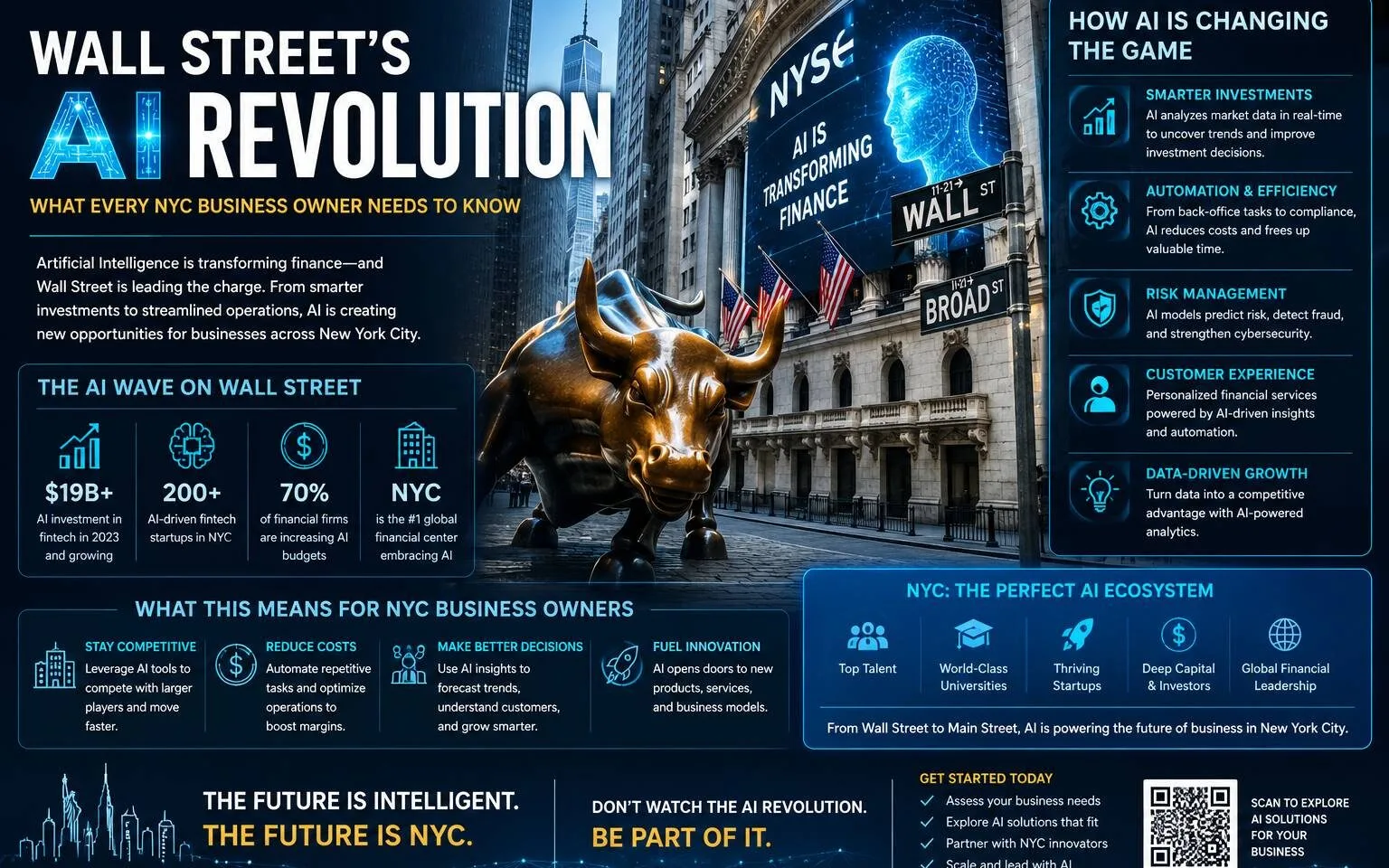
Something seismic is happening a few blocks south of City Hall, and its tremors are being felt in every borough, every industry, and every business in the five boroughs. Artificial intelligence has arrived on Wall Street, and it has not arrived quietly. The banks, hedge funds, private equity firms, and financial institutions that have defined New York City’s economy for two centuries are undergoing the most profound technological transformation in their history, and the ripple effects of that transformation will reshape the business landscape of this entire city for decades to come.
If you own or operate a business in New York City, whether you are running a ten-person accounting firm in Midtown, a manufacturing operation in the Bronx, a retail boutique in SoHo, or a logistics company in Staten Island, what is happening on Wall Street right now is not a story about someone else’s industry. It is a story about your vendors, your bankers, your investors, your competitors, your talent pool, and the economic environment in which every decision you make will play out over the next decade.
This is what you need to know.
The Scale of What Is Actually Happening
Let us start with the numbers, because the numbers are staggering even by Wall Street standards. The largest financial institutions in the world are not experimenting with artificial intelligence at the margins. They are making generational bets on it at the center of their operations.
JPMorgan Chase, headquartered right here in New York, has committed to spending over $17 billion annually on technology, with artificial intelligence as a central priority. The bank employs more than 2,000 AI and machine learning specialists and has filed hundreds of AI-related patents. CEO Jamie Dimon has described AI as potentially as transformative as the printing press, the steam engine, and the internet. When the head of one of the world’s largest banks reaches for those kinds of historical comparisons, he is not doing it for press release purposes. He is signaling an institutional conviction that AI is not a feature or a product but a fundamental rearchitecting of how financial services work.
Goldman Sachs has been equally aggressive. The firm has deployed AI tools across trading, investment banking, asset management, and operations, and has been transparent about its belief that AI will allow it to do more work with fewer people while simultaneously expanding into new markets and services. Goldman’s internal AI platform, which assists analysts and associates with research, document drafting, and data analysis, has been deployed to tens of thousands of employees.
Morgan Stanley has partnered with OpenAI to deploy one of the most ambitious AI assistants in the financial services industry, a tool called AI at Morgan Stanley Assistant that gives the firm’s 16,000 financial advisors instant access to the firm’s entire research library, enabling them to answer client questions with a speed and depth that was previously impossible.
Citigroup, BlackRock, Citadel, Two Sigma, and virtually every other major financial institution headquartered in or with major operations in New York has made comparable investments and commitments. The hedge fund industry, which has been using quantitative and algorithmic methods for decades, is undergoing its own AI acceleration as large language models and generative AI tools add new capabilities on top of existing quantitative frameworks.
The financial services industry is, by a significant margin, the largest single employer in New York City by wage share, accounting for roughly 35 percent of all private sector wages despite employing only about 8 percent of the workforce. What happens to that industry reverberates through every other sector of the city’s economy, from commercial real estate to restaurants to professional services to transportation. The AI transformation of Wall Street is not a financial industry story. It is a New York City story.
What AI Is Actually Doing Inside Financial Institutions Right Now
Before we can understand the implications for your business, it is worth being specific about what artificial intelligence is actually doing inside these institutions today, as opposed to what it might do in some hypothetical future. The applications are already live, already scaling, and already producing measurable results.
Trading and Market Analysis
AI systems now execute a substantial majority of trades on US equity markets. Algorithmic and high-frequency trading, which has been around for decades, has been significantly enhanced by machine learning models that can identify patterns and signals in market data that human traders would never detect. But the newer wave of AI is adding natural language capabilities on top of quantitative models, allowing trading systems to process earnings call transcripts, Federal Reserve statements, geopolitical news, and social media sentiment in real time and integrate those signals into trading decisions within milliseconds.
For hedge funds and proprietary trading desks, this is an arms race. The firms with the best AI systems will systematically outperform those with inferior ones over time, and the performance gaps will compound. This is already driving significant investment in AI talent, data infrastructure, and computing power across the industry.
Risk Management and Compliance
Financial institutions operate under the most complex and demanding regulatory frameworks of any industry in the world. The cost of compliance for a major bank runs into the billions of dollars annually, and the consequences of compliance failures can be existential. AI is being deployed aggressively to automate compliance monitoring, detect potential regulatory violations before they occur, and manage the vast documentation requirements that regulators impose.
Know Your Customer (KYC) and Anti-Money Laundering (AML) processes, which traditionally required armies of compliance professionals manually reviewing transactions and customer records, are being dramatically accelerated by AI systems that can process millions of transactions simultaneously and flag anomalies with a precision that human review simply cannot match. This is reducing costs significantly and, perhaps more importantly, reducing the risk of the kind of compliance failures that have cost major banks billions in fines over the past decade.
Investment Research and Analysis
The production of investment research has been one of the most labor-intensive processes in financial services, requiring teams of analysts to read financial statements, model company performance, track industry trends, and synthesize findings into research reports. AI is automating substantial portions of this process, allowing analysts to cover more companies with greater depth and to produce research faster than was previously possible.
Goldman Sachs has publicly stated that AI tools are enabling its analysts to complete in hours work that previously took days. This productivity improvement is not trivial. It is fundamentally changing the economics of investment research and the skill profile of the analysts being hired to produce it.
Customer Service and Financial Advice
The retail banking and wealth management businesses are deploying AI-powered chatbots and virtual assistants at enormous scale. Bank of America’s Erica virtual assistant has processed over two billion interactions. JPMorgan’s consumer banking AI tools handle millions of customer inquiries daily. These systems are not just answering simple questions. They are providing personalized financial guidance, identifying opportunities to offer products and services that are relevant to a specific customer’s situation, and flagging customers who may be in financial distress and need proactive outreach.
For wealth management, the Morgan Stanley AI assistant deployment is a harbinger of things to come. When a financial advisor can instantly access the synthesis of millions of pages of research, regulatory filings, and market data in response to a client question, the nature of the advisory relationship changes. The advisor’s value shifts from information retrieval and synthesis to interpretation, judgment, and relationship management.
Back Office and Operations
Perhaps the largest near-term impact of AI on financial institutions is in the back office: the vast infrastructure of settlement, reconciliation, reporting, data management, and administrative processing that underlies every financial transaction. These processes employ enormous numbers of people doing highly repetitive, rules-based work that AI systems can perform faster, more accurately, and at a fraction of the cost.
The implications for employment in these roles are real and are being actively discussed within these institutions, even if the public statements tend toward careful optimism about retraining and redeployment. We will address those implications directly in a later section.
The Fintech Acceleration: AI-Native Competitors Are Coming for Every Market
The AI revolution on Wall Street is not only happening inside the established institutions. It is simultaneously producing a new generation of AI-native fintech companies that are building from scratch with artificial intelligence at their core, and these companies are coming after markets that have traditionally been served by the combination of big banks and local professional services providers.
AI-native lending platforms are using machine learning models to underwrite loans faster and with fewer defaults than traditional credit scoring systems allow. This means small business owners who would previously have faced a lengthy and uncertain bank loan application process now have access to capital from platforms that can make credit decisions in hours rather than weeks, using data sources far richer than a traditional credit file.
AI-powered accounting and bookkeeping services are automating tasks that local bookkeepers and small accounting firms have traditionally performed. Invoice processing, expense categorization, bank reconciliation, and financial reporting are all being handled by AI systems at a cost point that is forcing established accounting service providers to either adopt the same tools or face displacement.
AI-native insurance underwriting platforms are using machine learning to price risk more accurately than traditional actuarial models, which is enabling them to offer more competitive premiums to lower-risk customers while better managing their exposure. For business owners who have watched their commercial insurance costs escalate in recent years, these platforms may offer genuinely better options as they scale.
AI-powered financial planning and tax advisory tools are increasingly capable of handling the routine financial planning and tax preparation work that previously required a human professional. The implication is not that accountants and financial advisors are going away, but that the work that justifies their fees is shifting toward judgment, strategy, and complex situations that AI cannot yet handle, which means providers who are not positioning themselves on those higher-value dimensions are under real competitive pressure.
What This Means for Your Relationship With Your Bank
For most New York City business owners, the most immediate and practical implication of Wall Street’s AI transformation involves your relationship with your bank. That relationship is changing in ways that can work in your favor if you understand what is happening.
Credit Decisions Are Getting Faster and More Data-Driven
AI-powered credit underwriting is enabling banks to make small business lending decisions significantly faster than traditional processes allowed. Where a commercial loan application might previously have taken weeks to underwrite, AI systems can now analyze financial statements, cash flow data, industry benchmarks, and alternative data sources and produce a credit recommendation in hours.
This is broadly good news for business owners who need access to capital quickly, but it comes with an important implication: the data you are generating about your business matters more than ever. Your accounting records, your payment history, your revenue consistency, your digital footprint, and even data about your industry peers are all being fed into AI underwriting models. Maintaining clean, accurate, and up-to-date financial records is no longer just good housekeeping. It is a direct input into the credit decisions that determine your cost of capital and access to financing.
Personalization Is Increasing, But So Is Algorithmic Decision-Making
AI is enabling banks to offer more personalized products and services to business customers, which sounds appealing. And in many respects it is: you may find that your bank proactively offers you a line of credit before you need to ask, or alerts you to a cash flow pattern that suggests you should restructure your debt, or identifies a treasury management product that fits your specific situation.
But increased personalization also means increased algorithmic decision-making, and algorithmic systems can embed biases and make errors that are difficult to identify and challenge. If your business is turned down for credit or offered unfavorable terms by an AI underwriting system, understanding what factors drove that decision and how to address them requires a different kind of engagement than the traditional conversation with a relationship banker who can exercise discretion and advocate internally on your behalf.
The practical advice here is to maintain a genuine relationship with a human relationship manager at your bank, even as AI systems take over more of the routine interactions. That relationship becomes your channel for understanding and if necessary appealing algorithmic decisions that affect your business.
Treasury Management and Cash Optimization
For business owners who maintain significant cash balances, AI-powered treasury management tools are making it significantly easier to optimize how you hold and deploy that cash. Automated sweep accounts, dynamic money market allocation, and real-time cash flow forecasting tools are becoming available to businesses that previously could not afford the treasury management sophistication that was reserved for large corporations.
If your bank has not approached you about these capabilities, it is worth asking. The competitive pressure from fintech alternatives is pushing traditional banks to offer more sophisticated treasury tools to smaller business customers than they would have considered serving with such products even five years ago.
The Commercial Real Estate Connection: A Critical Warning for NYC Business Owners
This section requires direct and unvarnished attention, because the commercial real estate implications of Wall Street’s AI transformation represent one of the most significant risks to the New York City business environment over the next five to ten years.
Financial institutions have historically been among the largest occupiers of commercial office space in New York City. The banks, trading firms, asset managers, and financial services companies clustered in Midtown and Lower Manhattan have filled millions of square feet of premium office space and paid some of the highest rents per square foot of any industry in any city in the world.
The AI transformation of financial services is directly reducing the headcount required to perform many of the functions that have filled those offices. Back-office processing roles, junior analyst positions, compliance monitoring jobs, and a wide range of middle-office functions are being automated or significantly reduced. This is happening against a backdrop of a commercial real estate market in New York that is already under significant stress from the remote work shift, with office vacancy rates that remain elevated well above pre-pandemic levels.
If large financial institutions continue to reduce headcount as AI productivity gains accumulate, and if that headcount reduction translates into reduced office footprints, the downstream effects on commercial real estate values, property tax revenues, and the retail and hospitality businesses that serve office workers could be substantial.
For business owners in neighborhoods that depend heavily on financial services workers as customers, specifically the restaurants, retail shops, dry cleaners, coffee shops, and service businesses in the Financial District, Midtown, and the surrounding areas, this is a risk that deserves serious strategic attention. Diversifying your customer base, building stronger ties to residential rather than purely office-worker customers, and monitoring occupancy trends in your neighborhood are all prudent responses to a risk that is real even if its timing and magnitude remain uncertain.
The Talent Market Transformation: What Happens to the Workforce
The question of what Wall Street’s AI revolution means for employment is one of the most consequential and contested questions in the New York City economy. As a business owner, you are affected by this both as a potential employer of people coming out of financial services and as a participant in a labor market that is being reshaped by technological change at a pace that is genuinely unprecedented.
Roles That Are Being Reduced
There are categories of financial services employment that are clearly being reduced by AI, and it is important to be honest about that rather than retreating to comfortable platitudes about technology always creating as many jobs as it destroys.
Data entry and processing roles, which have employed large numbers of workers in financial services back offices, are being automated at an accelerating pace. Junior analyst roles that primarily involved data gathering, spreadsheet modeling, and report compilation are being significantly reduced as AI tools automate those tasks. Certain compliance and KYC roles that required humans to manually review documents and transactions are being replaced by AI monitoring systems.
These are not entry-level roles that were on their way out anyway. Many of them paid salaries well above the city median and were important rungs on the career ladder that allowed people without elite educational credentials to build careers in financial services through demonstrated performance. The loss of these entry points has implications not just for the individuals affected but for the broader pipeline of talent and economic mobility that financial services has historically provided.
Roles That Are Being Created and Expanded
At the same time, financial services AI is creating significant demand for new kinds of roles and expanding the need for human judgment in areas where AI assistance makes humans more productive rather than unnecessary.
AI engineers, machine learning specialists, data scientists, and AI product managers are in enormous demand across every major financial institution in the city. These roles command premium compensation and represent genuinely new employment that did not exist before. For New York City’s tech ecosystem, the financial services industry’s appetite for AI talent is a significant driver of demand that is helping to support the broader technology economy.
Roles that require complex judgment, client relationships, regulatory expertise, and the ability to work effectively with AI tools are expanding. The financial advisor who can leverage AI research capabilities to serve more clients more effectively. The compliance officer who can interpret the output of AI monitoring systems and make judgment calls about edge cases. The investment banker who uses AI to produce better analysis faster and frees up time for the relationship and advisory work that clients actually value. These roles are not disappearing. In many cases they are becoming more valuable precisely because AI has automated the routine work that used to consume much of the professional’s time.
The Talent That Is Coming to Market
For business owners outside the financial services industry, the AI transformation of Wall Street is creating an interesting opportunity. Talented professionals who built their careers in financial services are finding that their roles have been eliminated or significantly changed, and some of them are looking for new opportunities in adjacent industries where their skills in analysis, process management, risk assessment, and data interpretation are genuinely valuable.
A compliance professional who has spent a decade managing regulatory requirements at a major bank brings skills that are directly applicable to compliance functions at healthcare companies, fintech startups, and any business operating in a regulated industry. A financial analyst whose role has been partially automated may have the analytical and modeling skills that a growing small business has always needed but could never afford to hire. This talent migration is real and it is an opportunity for business owners who are paying attention.
AI Tools That Are Available to Your Business Right Now
The AI revolution is not only happening inside the glass towers on Park Avenue and Broad Street. The same underlying technologies that Goldman Sachs and JPMorgan are deploying at enterprise scale are available to your business today, often at a price point that makes them accessible even for small operations. Here is a practical overview of the categories of AI tools that New York City business owners should be evaluating right now.
Financial Management and Accounting
AI-powered accounting platforms like QuickBooks with AI features, Xero, and newer AI-native tools like Puzzle and Decimal can automate large portions of your bookkeeping, categorize transactions with high accuracy, generate financial reports, and flag anomalies that might indicate errors or fraud. For businesses that are currently paying for manual bookkeeping services or spending owner time on financial administration, these tools can reduce costs and improve accuracy simultaneously.
AI-powered cash flow forecasting tools can analyze your historical revenue patterns, outstanding invoices, and upcoming obligations to produce forward-looking cash flow projections that help you anticipate shortfalls and make better financing decisions. This kind of financial intelligence was previously available only to businesses large enough to employ a dedicated CFO or finance team.
Customer Service and Communication
AI-powered customer service tools, from chatbots that handle routine inquiries to email response assistants that draft replies to customer questions, can significantly reduce the time and labor cost of managing customer communications. For businesses with high volumes of routine customer inquiries, whether you are running an e-commerce operation, a professional services firm, or a hospitality business, these tools can handle a substantial portion of the incoming communication load without human intervention.
Marketing and Content
AI writing and content creation tools have become genuinely capable of producing first drafts of marketing copy, email campaigns, social media content, and website copy that a human editor can review and refine. For small business owners who have limited marketing budgets and no dedicated marketing staff, these tools can dramatically increase the volume and quality of marketing content they are able to produce.
Operations and Process Automation
AI-powered workflow automation tools can connect your existing software systems, automatically route information between them, and handle repetitive operational tasks that currently require manual intervention. Scheduling, invoice processing, vendor communication, and reporting tasks that currently consume staff time can often be substantially automated with tools that are accessible and affordable for businesses of almost any size.
Competitive Intelligence and Market Analysis
AI research and intelligence tools can monitor your competitive landscape, track industry news, analyze customer reviews, and synthesize market information in ways that previously required significant time investment or expensive market research services. For business owners who need to stay current on their industry and competitive environment, these tools can dramatically reduce the time required to maintain that awareness.
The Regulatory Landscape: What New York Businesses Need to Watch
Wall Street’s AI revolution is unfolding against a regulatory backdrop that is actively evolving, and the regulatory decisions being made right now about how financial AI will be governed will have implications for every business in the city. As a New York City business owner, there are several regulatory dimensions of this story that deserve your attention.
Federal Financial Regulation and AI
The Securities and Exchange Commission, the Federal Reserve, the Office of the Comptroller of the Currency, and the Consumer Financial Protection Bureau are all actively developing frameworks for regulating AI in financial services. These frameworks are likely to impose new requirements on how AI systems are used in credit decisions, trading, compliance monitoring, and customer interactions.
For business owners, the most immediately relevant regulatory dimension involves AI in credit and lending decisions. Regulators are paying close attention to whether AI underwriting systems produce discriminatory outcomes and are developing guidance that will require lenders to be able to explain the factors that drove adverse credit decisions. If your business is denied credit by an AI-powered underwriting system, your rights to understand and challenge that decision are an active area of regulatory development.
New York State and City AI Governance
New York State and New York City have both been active in developing AI-related regulations and guidelines, and this regulatory activity is accelerating. New York City’s Local Law 144, which took effect in 2023 and governs the use of AI in hiring and employment decisions, was one of the first municipal AI regulations in the United States and established a model that other jurisdictions are now following.
If you are using AI tools in your hiring process, which includes any automated screening or scoring of job applicants, you need to be aware of your compliance obligations under Local Law 144. The law requires bias audits of covered AI hiring tools and mandates specific disclosures to job candidates. Penalties for non-compliance are real, and the enforcement environment is active.
Expect the regulatory framework around AI to expand significantly in the coming years. New York’s aggressive posture on consumer protection, financial regulation, and employment law makes it one of the more likely jurisdictions to move quickly on AI governance across multiple domains, and business owners should be tracking these developments closely.
Data Privacy and AI
The AI systems being deployed by financial institutions and by the fintech tools available to your business all depend on data, often including data about your customers, your employees, and your business operations. New York’s existing privacy laws, combined with the evolving federal landscape around data privacy, create a compliance environment that every business using AI tools needs to understand.
At a minimum, business owners should review the data practices of any AI tools they are using, ensure they understand what data those tools collect and how it is used, and verify that their use of AI does not conflict with any commitments made to customers or employees about data privacy.
The Opportunity in the Disruption: How Smart NYC Business Owners Are Positioning Themselves
Every major technological disruption creates as much opportunity as it destroys, and Wall Street’s AI revolution is no exception. The question is not whether AI will change the financial and business environment in New York City. It already has and it will continue to accelerate. The question is which business owners will be positioned to benefit from those changes rather than be overwhelmed by them.
Becoming AI-Literate Is Now a Business Competency
The single most important thing you can do as a New York City business owner in the current environment is develop genuine AI literacy. This does not mean you need to understand how large language models work at a technical level. It means you need to understand what AI tools are capable of in your specific industry, what they are not yet capable of, and how to evaluate whether a given AI application is producing the results it claims.
Business owners who develop this competency will make better technology investment decisions, hire more effectively in an AI-augmented talent market, engage more productively with financial institutions that are deploying AI, and identify opportunities to deploy AI in their own operations before their competitors do.
Positioning Your Business as a Supplier to the AI Transformation
Wall Street’s AI transformation requires an enormous supporting ecosystem of products and services that are not being built by the banks themselves. Data infrastructure, computing services, specialized AI training data, legal and compliance services specific to AI regulation, change management consulting, AI literacy training, and dozens of other supporting services represent real business opportunities for New York City companies with relevant expertise.
If your business operates in professional services, technology services, staffing, training, or any domain that intersects with the operational needs of financial institutions undergoing AI transformation, there may be a significant opportunity to position your firm as a specialized provider to that transformation process.
Attracting the Talent That Is Transitioning Out of Financial Services
As discussed earlier, Wall Street’s AI transformation is releasing talented professionals into the broader labor market. Business owners who recognize the value of this talent and create attractive opportunities for professionals with financial services backgrounds can significantly upgrade their team’s analytical capabilities, risk management sophistication, and institutional process discipline at a cost that may be more accessible than it would have been before the current wave of financial services displacement.
Building Deeper Customer Relationships That AI Cannot Replace
In a world where AI is automating an increasing share of transactional and informational interactions, the value of genuine human relationships, deep local knowledge, and the kind of trust that can only be built over time through consistent personal engagement is actually increasing rather than decreasing. For local New York City businesses, this is a genuine competitive advantage over national and global competitors who are relying primarily on AI-mediated customer relationships.
The restaurant that knows its regulars by name and remembers their preferences. The accountant who has a deep understanding of a client’s family financial situation and business history. The contractor who has built a reputation over twenty years in a specific neighborhood. These relationship assets are not replaceable by AI, and in an environment where AI is making transactional relationships cheaper and more efficient, the premium on authentic human connection and local trust is rising.
Practical Steps for New York City Business Owners: An Action Framework
All of the above analysis is only valuable if it leads to action. Here is a practical framework for what New York City business owners should be doing right now in response to Wall Street’s AI revolution.
Audit Your Current Use of AI and Your Exposure to AI-Driven Change
Start by taking stock of where AI already touches your business, whether through the tools you are using, the financial services providers you depend on, or the competitive dynamics of your industry. Identify where AI is likely to create new competition for your business and where it might automate tasks you are currently paying people or spending your own time to perform.
Review Your Banking and Financial Services Relationships
Evaluate whether your current banking relationships are positioned to serve your business well as AI transforms financial services. Make sure you have a genuine relationship with a human banker who can advocate for your business within the institution. Explore what AI-powered treasury, lending, and financial management tools your current providers offer that you are not yet using. And consider whether there are fintech alternatives that might offer better terms or more appropriate products for your specific situation.
Identify Two or Three AI Tools to Pilot in Your Business This Year
Rather than trying to overhaul your entire operation at once, pick two or three specific applications where AI tools are likely to deliver measurable value and run genuine pilots. Set clear success metrics before you start, evaluate honestly against those metrics, and build your AI competency incrementally based on what you learn.
Stay Current on the Regulatory Environment
AI regulation is moving quickly at the federal, state, and city level. Subscribe to updates from the New York City Department of Small Business Services, the New York State Department of Financial Services, and relevant trade associations for your industry. Ensure that any AI tools you are using or considering using are compliant with current requirements and track how those requirements are evolving.
Invest in Your Own and Your Team’s AI Literacy
Allocate time and budget for AI education within your business. This does not need to be expensive. There are high-quality free and low-cost resources available from universities, professional associations, and online platforms. The goal is to ensure that you and the key decision-makers in your business understand enough about AI capabilities and limitations to make sound strategic and operational judgments in an AI-saturated environment.
The Bigger Picture: New York City in the AI Economy
Wall Street’s AI revolution is playing out in the context of a broader transformation of the New York City economy that has been building for more than a decade. The city that was once primarily a finance and media town has evolved into one of the world’s leading technology hubs, and the AI acceleration of that transformation is accelerating a rebalancing of economic power within the city.
The neighborhoods, industries, and businesses that will thrive in the AI economy are those that combine New York’s enduring advantages, its density, its diversity, its industry expertise, its talent magnetism, its global connections, with the intelligent adoption of AI tools that amplify human judgment rather than replacing it.
This city has reinvented itself more times than any other in American history. It survived the departure of manufacturing, the fiscal crisis of the 1970s, the devastation of September 11th, the financial crisis of 2008, and the COVID-19 pandemic. Each time, it emerged with a more resilient, more diverse, and ultimately more dynamic economy. The AI revolution will be no different.
The financial institutions leading this transformation are not doing it in a vacuum or in a campus in the middle of a valley in California. They are doing it here, in New York City, surrounded by the restaurants and small businesses and professional services firms and logistics companies and creative agencies that make up the full texture of this city’s economy. The AI revolution is a New York story, and that means it is your story too.
Conclusion: Act With Urgency, But Not With Panic
If there is a single message for New York City business owners to take from this analysis, it is this: the AI transformation of Wall Street and the broader financial services industry is real, it is already well underway, and its effects will be felt in every corner of the city’s economy over the next decade. Business owners who understand what is happening and position themselves accordingly will have real advantages. Those who ignore it or assume it is someone else’s problem will find themselves increasingly exposed to competitive and economic pressures they did not anticipate.
But urgency is not the same as panic. The most important qualities for navigating this moment are the qualities that have always defined successful New York City business owners: clear-eyed realism about what is actually happening, the intellectual curiosity to keep learning in a rapidly changing environment, the pragmatism to adopt new tools and approaches when they deliver genuine value, and the confidence that comes from knowing your customers, your market, and your community in ways that no algorithm can fully replicate.
Wall Street’s AI revolution is rewriting the rules of finance. But the fundamentals of building a great business in New York City, knowing your customers, delivering real value, building genuine relationships, and adapting relentlessly to a city that never stops changing, those are not being rewritten by any algorithm. They are as true today as they were when your grandfather ran a business on Delancey Street or your mother opened her practice in Flushing.
New York has always been a city that bends the future to its will rather than the other way around. The AI revolution is the next chapter in that story, and you are part of writing it.

