

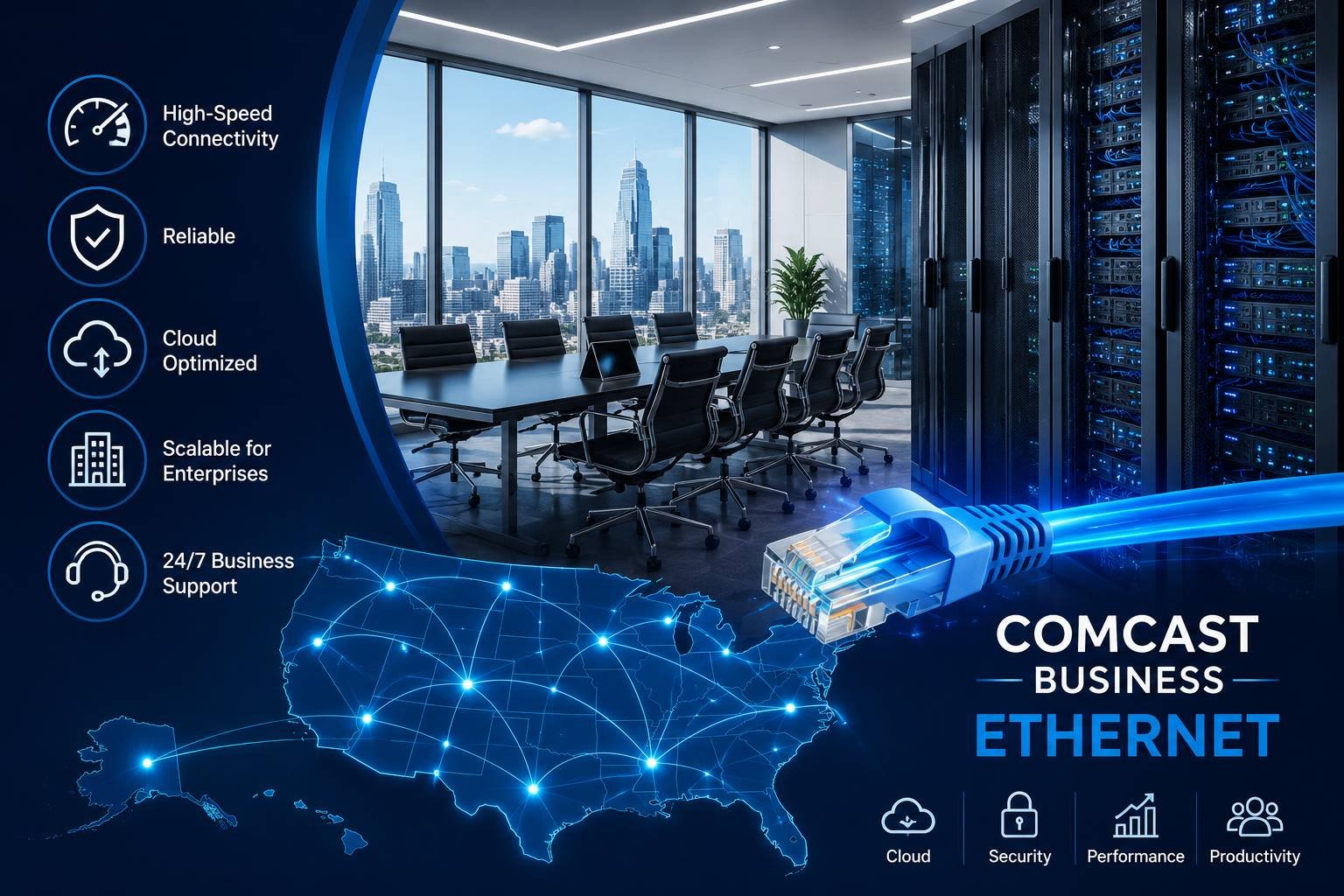
For most large organizations, the network is no longer just plumbing in the background. It is the platform that everything else runs on. Cloud applications, video meetings, point-of-sale systems, electronic health records, and AI workloads all depend on a connection that is fast, predictable, and always there.
When that connection wobbles, productivity and revenue go with it. That shift in expectations is a big part of why a growing number of US enterprises are moving away from shared broadband and toward carrier-grade Ethernet.
Comcast Business Ethernet has become a common destination in that migration, and this guide explains why. We will look at what the service actually is, the business problems it solves, how it stacks up against fiber broadband and rival carriers, and what decision makers should weigh before they sign.
Introduction to Comcast Business Ethernet Services
Comcast Business Ethernet is a family of fiber-based connectivity services built for organizations that have outgrown standard business internet. Rather than a single product, it is a portfolio designed to handle dedicated internet access, private site-to-site links, and complex multi-location networks across the country.
The lineup centers on four core services: Ethernet Dedicated Internet, Ethernet Private Line, Ethernet Virtual Private Line, and Ethernet Network Service. Capacity scales from modest speeds all the way up to 100 Gbps, with even higher options available in select markets.
Everything runs over Comcast’s national fiber backbone and is monitored around the clock from its network operations centers.
In plain terms, this is the kind of connectivity that used to be reserved for the very largest companies, now packaged for any enterprise that needs reliability it can count on.
Why Enterprise Connectivity Matters More Than Ever
A decade ago, an office could limp along on a shared connection because most work happened on local servers and desktop software. That world is gone. Today the typical enterprise runs dozens of cloud platforms, hosts video calls all day, moves large files to and from data centers, and expects every branch to perform like headquarters.
This creates a hard requirement for bandwidth that is both generous and consistent. A connection that delivers blazing speeds at 6 a.m. but crawls during the afternoon rush is a liability. Enterprises need a network that performs the same at peak load as it does overnight, because their operations do not pause.
The question enterprises ask is no longer “how fast can it go” but “how reliable is it when everyone is using it at once.” Those are very different things, and they lead to very different network decisions.
Why US Enterprises Are Moving Away From Traditional Broadband
Traditional broadband, including standard cable and DSL, is a shared medium. Your bandwidth is pooled with other subscribers in the area, so performance fluctuates with neighborhood demand. For a coffee shop that is fine. For a hospital or a trading floor it is not.
Three frustrations push enterprises off shared broadband. First, speeds are usually asymmetrical, with far less upload than download, which hurts cloud backups and video. Second, there is rarely a meaningful service level agreement, so when it breaks you wait in the same queue as everyone else. Third, performance is unpredictable, which makes capacity planning a guessing game.
Dedicated Ethernet services solve all three. You get committed bandwidth that is yours alone, symmetrical speeds, and contractual performance guarantees. For organizations where downtime carries a real dollar cost, that combination is worth paying for.
The Cloud and Remote Work Effect
Two forces accelerated this migration more than anything else. The first is the move to cloud computing and software as a service. When your core applications live in Microsoft 365, Salesforce, AWS, Google Cloud, or a dozen niche SaaS tools, your internet connection effectively becomes your application backbone.
Latency and packet loss that were once invisible now show up as laggy dashboards and dropped calls. The second is the permanent shift to hybrid and remote work. Branch offices, home workers, and headquarters all need to reach the same cloud resources and connect back through VPNs and SD-WAN overlays.
That places sustained, symmetrical demand on every site at once. A network designed for occasional bursts cannot keep up with that pattern, and enterprises have learned this the hard way.
The Demand for Low Latency and High Uptime
Two metrics dominate enterprise networking conversations: latency and uptime. Latency is the delay before data starts moving, and it determines how responsive applications feel. Uptime is the percentage of time the connection is actually available.
Comcast positions its dedicated services around carrier-grade reliability, citing network reliability around 99.99 percent and offering redundancy options for sites that cannot tolerate any interruption.
Low and consistent latency matters just as much, because real-time applications like voice and video degrade quickly when delay creeps up. Dedicated Ethernet keeps both metrics tight, which is exactly what latency-sensitive workloads require.
How Comcast Business Ethernet Supports Digital Transformation
Digital transformation is an overused phrase, but underneath it sits a concrete reality: enterprises are digitizing processes that used to be manual, and those digital processes need rock-solid connectivity to function.
A retailer rolling out real-time inventory across hundreds of stores, a manufacturer connecting factory sensors to a cloud analytics platform, a clinic moving to telehealth, all of these depend on a network that can carry the traffic reliably.
Comcast Business Ethernet acts as the foundation layer for these initiatives, providing the dedicated bandwidth, predictable performance, and scalability that transformation projects assume but rarely budget for properly. You can pair it with our guidance on building a cloud-ready network architecture to plan the rollout.
Dedicated Internet vs Shared Internet Connections
This distinction sits at the heart of the enterprise decision, so it is worth being precise about it.
| Characteristic | Shared Broadband | Dedicated Ethernet |
|---|---|---|
| Bandwidth allocation | Shared with other users | Reserved for your business |
| Speed symmetry | Usually asymmetrical | Symmetrical upload and download |
| Performance at peak times | Can slow down | Consistent |
| Service level agreement | Limited or none | Contractually guaranteed |
| Best fit | Small sites, light use | Enterprise and mission-critical use |
A dedicated connection means the bandwidth you buy is the bandwidth you get, at any hour, regardless of what other businesses nearby are doing. For enterprise operations, that predictability is often more valuable than raw headline speed.
Benefits of Ethernet Services for Large Organizations
The advantages stack up quickly once you move to a dedicated Ethernet platform.
- Symmetrical bandwidth. Equal upload and download speeds make cloud backups, large file transfers, and video conferencing dramatically smoother.
- SLA-backed performance. Guarantees around availability, latency, and repair times give IT teams something concrete to plan and report against.
- Scalability. Capacity can grow from a few megabits to many gigabits without ripping out the underlying connection.
- Multi-site consistency. Every location can be brought onto the same network with uniform performance and management.
- Security. Private Ethernet options keep sensitive traffic off the public internet entirely.
Why Symmetrical Bandwidth Is a Big Deal
Consumer connections are built for downloading, so they offer far more download than upload speed. Enterprises do the opposite of consumers all day long. They push data up to the cloud, send video out to remote participants, replicate databases to backup sites, and sync files across locations.
Symmetrical bandwidth removes the upstream bottleneck that quietly throttles all of these tasks on a standard connection.
The Comcast Business Ethernet Portfolio Explained
Each service in the lineup targets a specific networking need. Understanding the differences helps match the product to the problem.
| Service | Topology | Primary Use |
|---|---|---|
| Ethernet Dedicated Internet | Dedicated link to the public internet | Reliable, symmetrical internet access with an SLA |
| Ethernet Private Line | Point to point between two sites | Secure, private connection for mission-critical traffic |
| Ethernet Virtual Private Line | Point to multipoint | Connecting one hub site to several locations flexibly |
| Ethernet Network Service | Multipoint to multipoint | Meshing many locations into one private network |
Ethernet Dedicated Internet
This is the workhorse for organizations that need fast, reliable, symmetrical access to the public internet. The bandwidth is not shared, speeds are equal in both directions, and the service is backed by an SLA.
It typically comes with permanent IP addresses and optional managed router and firewall services, which is ideal for a headquarters or any site that lives in the cloud.
Ethernet Private Line
Ethernet Private Line creates a dedicated, point-to-point connection between two of your sites that never touches the public internet. It is the modern replacement for legacy TDM private lines and is well suited to latency-intolerant work such as data center integration and the movement of sensitive data. Class of service controls let you prioritize the most important traffic across the link.
Ethernet Virtual Private Line and Ethernet Network Service
When you move beyond two sites, these two services take over. Ethernet Virtual Private Line connects a central location to multiple branches in a hub-and-spoke pattern, letting you tailor bandwidth and cost per site.
Ethernet Network Service goes further, meshing many locations together in a multipoint-to-multipoint private network so every site can talk to every other site directly. Both are built for distributed enterprises that want one cohesive, private backbone.
SD-WAN and Hybrid Networking Support
Few enterprises run a single connection type anymore. Most blend dedicated Ethernet at major sites with broadband or wireless at smaller ones, then tie it all together with SD-WAN. Software-defined wide area networking intelligently routes traffic across multiple links, sending cloud traffic out the most efficient path and prioritizing critical applications.
Comcast offers SD-WAN alongside its Ethernet services, plus managed security and unified communications, which lets enterprises consolidate networking and security under one provider.
The advantage is operational simplicity: a single relationship, a coordinated set of tools, and one team to call when something needs attention. For a deeper look, see our explainer on how SD-WAN improves multi-site performance.
Security and Network Stability Benefits
Security improves on two fronts with enterprise Ethernet. The private line services keep sensitive traffic off the public internet altogether, which shrinks the attack surface and supports compliance for regulated data.
On the internet-facing side, Comcast layers in managed router and firewall services, DDoS mitigation, and a Cisco Meraki-based technology stack that unifies network and security management through a cloud dashboard.
Stability comes from the underlying design. A dedicated, monitored, fiber-based network simply behaves more predictably than a shared connection, and 24/7 monitoring from dedicated network operations centers means problems are often spotted before customers notice them.
Business Continuity and Disaster Recovery
Downtime is not just an inconvenience for an enterprise. A few hours offline can mean missed orders, idle staff, failed transactions, and reputational damage. That is why business continuity is a core reason organizations choose dedicated Ethernet.
Redundancy options allow a secondary connection or path to take over if the primary link fails, keeping operations running. Private Ethernet links between a primary site and a disaster recovery facility make real-time data replication practical, so a failover site is genuinely ready when needed. For any organization with a continuity plan on paper, the network is what turns that plan into reality.
Performance for Cloud Applications and SaaS Platforms
The quality of a SaaS experience is largely decided by the network underneath it. Comcast also offers private connectivity directly to major cloud providers, bypassing the public internet for traffic headed to platforms like AWS, Microsoft Azure, and Google Cloud. This cuts latency, improves consistency, and adds a layer of security for cloud-bound workloads.
For an enterprise running its ERP, CRM, and productivity suite in the cloud, this kind of direct, predictable path is the difference between applications that feel local and applications that feel sluggish. As cloud dependence deepens, that performance edge compounds.
Optimizing Voice, Video, and Collaboration
Real-time communication is where network quality becomes immediately obvious. Choppy video, robotic voice, and dropped calls are almost always symptoms of jitter, latency, or insufficient upstream bandwidth.
Symmetrical dedicated bandwidth gives voice over IP and video conferencing the headroom they need in both directions, while class of service controls let the network prioritize this traffic over less urgent data.
The result is collaboration tools that work the way vendors promise, which matters more than ever now that meetings are mostly virtual.
Data-Heavy Industries Using Comcast Ethernet
Some sectors feel the benefits of dedicated Ethernet more acutely than others because their operations are unusually data-intensive or downtime-sensitive.
| Industry | Why Dedicated Ethernet Matters |
|---|---|
| Healthcare | Electronic health records, imaging, and telehealth need reliable, secure, compliant connectivity |
| Finance | Transactions and trading demand low latency, security, and near-perfect uptime |
| Retail | Point of sale, inventory, and e-commerce span many locations and cannot go dark |
| Logistics | Tracking, routing, and warehouse systems run on constant real-time data |
| Education | Campuses support thousands of users, online learning, and research workloads |
| Manufacturing | Connected machinery, IoT sensors, and analytics require stable, scalable links |
In each case the pattern is the same. The business has digitized something essential, and a flaky connection puts that essential function at risk. Dedicated Ethernet removes that risk from the equation.
Comcast Business Ethernet vs Fiber Broadband
People sometimes assume fiber broadband and dedicated Ethernet are the same because both can use fiber. They are not. The medium is similar, but the service model is very different.
| Factor | Fiber Broadband | Dedicated Ethernet |
|---|---|---|
| Bandwidth | Shared, best effort | Dedicated, guaranteed |
| Symmetry | Often asymmetrical | Symmetrical |
| SLA | Minimal | Strong, contractual |
| Private site links | Not available | Available |
| Cost | Lower | Higher, reflecting guarantees |
Fiber broadband is an excellent value for smaller sites and lighter workloads. Dedicated Ethernet is the right call when guaranteed performance, symmetry, and private connectivity are non-negotiable. Many enterprises use both, matching the service to each site’s importance.
Comcast vs AT&T Business
AT&T is a major enterprise connectivity provider with its own dedicated internet, switched Ethernet, and MPLS offerings, plus a strong nationwide and global footprint and deep wireless integration. It is a serious competitor, particularly for organizations that want tightly integrated mobility and a long history of enterprise contracts.
Where Comcast often appeals is in markets where its fiber footprint is strong, in its bundling of internet, Ethernet, SD-WAN, and managed security under one roof, and in its responsiveness for mid-market and enterprise customers.
As with any carrier, the honest answer depends heavily on availability and pricing at your specific addresses, which is why both should be quoted side by side.
Comcast vs Verizon Business
Verizon is another heavyweight, known for an extensive global network, robust private IP and MPLS services, and a leading position in wireless and emerging 5G enterprise solutions. For multinational organizations or those leaning heavily on wireless and mobile edge use cases, Verizon is a natural shortlist candidate.
Comcast competes effectively in the US domestic market, especially where its fiber reaches, and tends to be valued for straightforward dedicated Ethernet, competitive pricing, and a consolidated portfolio. The practical takeaway is the same as with AT&T: compare actual quotes, confirm availability, and weigh the managed services each can deliver at your locations rather than relying on brand reputation alone.
Enterprise Scalability and Cost Efficiency
Growth is messy for networks. Add locations, headcount, and applications, and a connection that was comfortable last year becomes a bottleneck this year. Dedicated Ethernet is built to scale, letting you increase bandwidth on the same service as demand rises rather than re-architecting every time.
On cost, the headline price of Ethernet is higher than broadband, but the comparison should be made on value, not sticker. Downtime, lost productivity, failed transactions, and emergency fixes all carry costs that a reliable connection avoids.
For organizations where the network underpins revenue, the math frequently favors dedicated services once the true cost of unreliability is counted.
Future-Ready Infrastructure for AI and IoT
The next wave of demand is already visible. AI workloads move enormous datasets to and from the cloud and benefit from low, consistent latency. IoT deployments connect thousands of sensors and devices, each generating a constant trickle of data that adds up fast. Both trends push bandwidth and reliability requirements steadily upward.
A platform that scales to 100 Gbps and beyond, with private cloud connectivity and SD-WAN flexibility, is well positioned for these workloads. Choosing infrastructure with this kind of headroom means enterprises are not forced into a disruptive overhaul the moment an AI or IoT initiative takes off.
Network Management and IT Efficiency
Every hour IT spends babysitting the network is an hour not spent on projects that move the business forward. Managed and co-managed options let Comcast handle day-to-day network operations, from routers and firewalls to monitoring and security, freeing internal teams to focus on higher-value work.
A unified, cloud-based management dashboard adds visibility across sites, which is a meaningful advantage for lean IT departments supporting many locations. The combination of managed services and centralized control is often as compelling to decision makers as the connectivity itself.
Comcast Network Coverage in the United States
Comcast operates one of the largest fiber networks in the country, spanning hundreds of thousands of route miles and reaching a broad set of major and secondary markets. The company reports serving the large majority of Fortune 500 companies, which speaks to the scale of its enterprise footprint.
That said, exact availability and the specific services offered vary by address. Some locations have full Ethernet and high-capacity options on tap, while others may have more limited choices. Confirming serviceability at each of your sites is an essential early step in any evaluation.
Branch Office Connectivity and Enterprise Mobility
Distributed organizations live or die by how well their branches connect. The Ethernet Virtual Private Line and Network Service products are designed precisely for linking many sites into one private network, while SD-WAN extends sensible, prioritized connectivity to smaller or temporary locations.
The goal is consistency. A worker at a branch office or a clinic across the state should experience the same responsive access to applications as someone at headquarters. A well-designed enterprise Ethernet deployment makes that consistency achievable across the entire footprint.
Also Read: NYC Business License and Permit Guide for Small Businesses
Common Challenges With Outdated Internet Infrastructure
Many enterprises do not realize how much their old infrastructure is costing them until they map the symptoms.
- Slowdowns during peak hours that frustrate staff and customers.
- Insufficient upload speed that cripples cloud backups and video.
- No meaningful SLA, leaving outages unresolved for hours.
- Patchwork connections across sites with inconsistent performance.
- Security gaps from routing sensitive traffic over the public internet.
- An inability to scale without disruptive forklift upgrades.
Each of these is a recurring drag on the business. Together they build a strong case for moving to a modern, dedicated platform.
Why Reliable Connectivity Shapes Customer Experience
Customers rarely see the network, but they feel it constantly. A slow checkout, a frozen video consultation, an app that times out, a call that drops, all of these trace back to connectivity, and all of them erode trust. In competitive markets, that erosion shows up directly in retention and revenue.
Reliable enterprise connectivity is therefore not just an IT concern. It is a customer experience investment. The organizations that understand this treat the network as a strategic asset rather than a line-item cost, and they choose providers accordingly.
Buying Considerations for Enterprise Ethernet Solutions
Selecting an enterprise Ethernet provider is a significant commitment, so it pays to evaluate carefully rather than chase the lowest quote.
Questions to Ask Before Choosing a Provider
- Is the service available at every one of my locations, and with what capacity?
- What exactly does the SLA guarantee for uptime, latency, and repair times?
- How quickly and easily can I scale bandwidth as we grow?
- What managed and security services are included or available?
- How is multi-site connectivity designed and priced?
- What redundancy and disaster recovery options exist?
- What does real-world support look like, and where are the operations centers?
Enterprise pricing is almost always custom, built from a quote based on location, bandwidth, term, and add-on services rather than a public price list.
That makes a careful, apples-to-apples comparison across providers essential. Our enterprise connectivity evaluation checklist can help structure that comparison.
The Future of Enterprise Networking in the USA
The direction of travel is clear. Bandwidth needs keep climbing, driven by cloud, AI, video, and IoT. Networks are becoming more software-defined and more automated. The line between connectivity and security is blurring as both converge into unified, managed platforms. And enterprises increasingly want a single provider that can deliver internet, private links, SD-WAN, and security as one coherent service.
Carrier Ethernet sits at the foundation of all of this. It is the dependable transport layer that the smarter, more automated overlays depend on. Providers that combine deep fiber reach with a full managed portfolio are well placed for where the market is heading.
Emerging Trends in Ethernet Connectivity
- Higher capacity as standard. Multi-gigabit and beyond is becoming the baseline expectation, not a premium tier.
- Direct cloud connectivity. Private on-ramps to major cloud providers are increasingly built into the network design.
- Convergence of network and security. Secure access models and managed security are folding into connectivity offerings.
- Automation and self-service. Dashboards and APIs are giving IT teams more control with less manual effort.
- AI-aware networking. Networks are being designed with the bursty, data-heavy patterns of AI workloads in mind.
Expert Recommendations for Choosing Business Ethernet Services
- Start with your applications and where they live, then size the network to serve them, not the other way around.
- Treat the SLA as a core part of the product and read it closely, because guarantees are where reliability becomes contractual.
- Plan for growth by choosing a platform that scales without a rebuild.
- Consolidate where it makes sense, since one provider for internet, private links, SD-WAN, and security reduces complexity.
- Always confirm serviceability and get custom quotes from more than one carrier before deciding.
- Weigh the true cost of downtime, not just the monthly price, when comparing options.
The Bottom Line
US enterprises are switching to Comcast Business Ethernet because the demands on their networks have fundamentally changed. Cloud platforms, hybrid work, real-time collaboration, and data-heavy operations all require connectivity that is dedicated, symmetrical, reliable, and backed by real guarantees.
Shared broadband was never built for that, and the gap shows up daily in lost productivity and frustrated customers. Comcast’s Ethernet portfolio addresses these needs directly, with dedicated internet, private site-to-site links, multi-location networking, SD-WAN, managed security, and a national fiber footprint, all monitored around the clock.
It is not the only capable provider, and a thorough comparison with carriers like AT&T and Verizon at your specific locations is always wise. But for many organizations, the combination of guaranteed performance, scalability, and a consolidated managed portfolio explains exactly why the migration is happening. In an era where the network is the business, that reliability is no longer a luxury. It is the baseline.
Also Read: How to Find the Right Commercial Space in New York City
Frequently Asked Questions
What are Comcast Business Ethernet services?
They are a portfolio of fiber-based connectivity services for enterprises, including Ethernet Dedicated Internet, Ethernet Private Line, Ethernet Virtual Private Line, and Ethernet Network Service. The services range from modest speeds up to 100 Gbps, with higher capacity in select areas, and they run over Comcast’s national fiber network with around-the-clock monitoring. They are designed for organizations that need guaranteed, symmetrical, reliable connectivity rather than shared broadband.
What is the difference between dedicated internet and shared internet?
Dedicated internet reserves bandwidth exclusively for your business, so performance stays consistent regardless of what others nearby are doing, and it usually comes with symmetrical speeds and a service level agreement. Shared internet pools bandwidth among many users, which means speeds can fluctuate at peak times and guarantees are limited. For enterprise and mission-critical operations, dedicated internet provides the predictability that shared connections cannot.
How reliable is Comcast Business Ethernet?
Comcast positions its dedicated services around carrier-grade reliability, citing network reliability near 99.99 percent and offering redundancy options for sites that cannot tolerate downtime. Dedicated services are backed by service level agreements covering availability and performance, and the network is monitored continuously from dedicated operations centers. Actual reliability still depends on your specific configuration and whether you add redundancy, so review the SLA details for your sites.
What factors affect Comcast Business Ethernet pricing?
Enterprise Ethernet pricing is custom rather than published. The main factors are the bandwidth you need, the type of service, the number and location of sites, the contract term, and any managed or security add-ons. Because pricing is quote-based, the best approach is to define your requirements clearly and request detailed quotes, ideally comparing more than one provider at the same locations.
Is Comcast Business Ethernet secure?
Yes, security is a core strength. Private line services keep sensitive traffic off the public internet entirely, which reduces exposure and supports compliance. For internet-facing connections, Comcast offers managed router and firewall services, DDoS mitigation, and a Cisco Meraki-based stack that unifies network and security management. The right mix depends on your risk profile and regulatory requirements.
Can Comcast Business Ethernet scale as my company grows?
Scalability is one of the main reasons enterprises choose Ethernet. Capacity can grow on the same service from a few megabits up to many gigabits, so you can add bandwidth as demand rises without rebuilding your connection. Multi-site products and SD-WAN make it straightforward to bring new locations onto the network as you expand, which suits fast-growing organizations.
Does it support remote and hybrid work?
It does. Symmetrical bandwidth handles the heavy upstream demands of cloud access, video calls, and VPN traffic that remote work generates. Combined with SD-WAN, the network can connect headquarters, branches, and remote users to the same cloud resources with consistent, prioritized performance. This makes it well suited to the sustained, all-day demand patterns that hybrid work creates.
How does it improve cloud application performance?
Cloud and SaaS performance depends heavily on the network beneath it. Dedicated, symmetrical bandwidth reduces bottlenecks, and Comcast also offers private connectivity directly to major cloud providers, bypassing the public internet for lower latency and more consistent performance. For enterprises that run core applications in the cloud, this direct path makes those applications feel faster and more dependable.
Can it connect multiple business locations?
Yes, this is a core capability. Ethernet Private Line connects two sites point to point, Ethernet Virtual Private Line links a central hub to multiple branches, and Ethernet Network Service meshes many locations into one private multipoint network. Together with SD-WAN, these options let distributed enterprises build a single, cohesive, private backbone with consistent performance across every site.
What does an SLA guarantee, and why does it matter?
A service level agreement is a contractual commitment covering things like uptime, latency, and how quickly issues are resolved. It matters because it turns reliability from a marketing claim into an enforceable promise, giving IT teams concrete targets to plan and report against. When evaluating providers, the specifics of the SLA are often as important as the bandwidth itself, so read them carefully.
How important is uptime for enterprise operations?
Uptime is critical. For most enterprises, even short outages translate into lost productivity, missed transactions, and frustrated customers, and in sectors like finance and healthcare the stakes are higher still. Dedicated Ethernet with strong SLAs and redundancy options is designed to keep operations running, which is why uptime guarantees are usually a top priority in the buying decision.
How do I know if Comcast Business Ethernet is available at my locations?
Availability and the specific services offered vary by address, even though Comcast operates one of the largest fiber networks in the country. The only reliable way to confirm is to check serviceability for each of your sites directly with the provider early in your evaluation. Doing this upfront prevents surprises later and helps you design a network that fits your actual footprint.
Published By Bizny.co