How NYC Became the Second Largest Startup Hub in the United States
New York City has transformed into one of the world’s leading startup ecosystems. Explore the key factors driving NYC’s rise as the second largest startup hub in the United States, from venture capital investment and tech talent to innovation, entrepreneurship, and business growth opportunities.

If you live in New York City, you already know this place has an energy unlike anywhere else on earth. The subway hum, the 24-hour bodegas, the relentless pace of midtown at 8 AM — it all adds up to something that Wall Street has known for centuries and Silicon Valley is just beginning to accept: New York does not play second fiddle to anyone. Not even in tech.
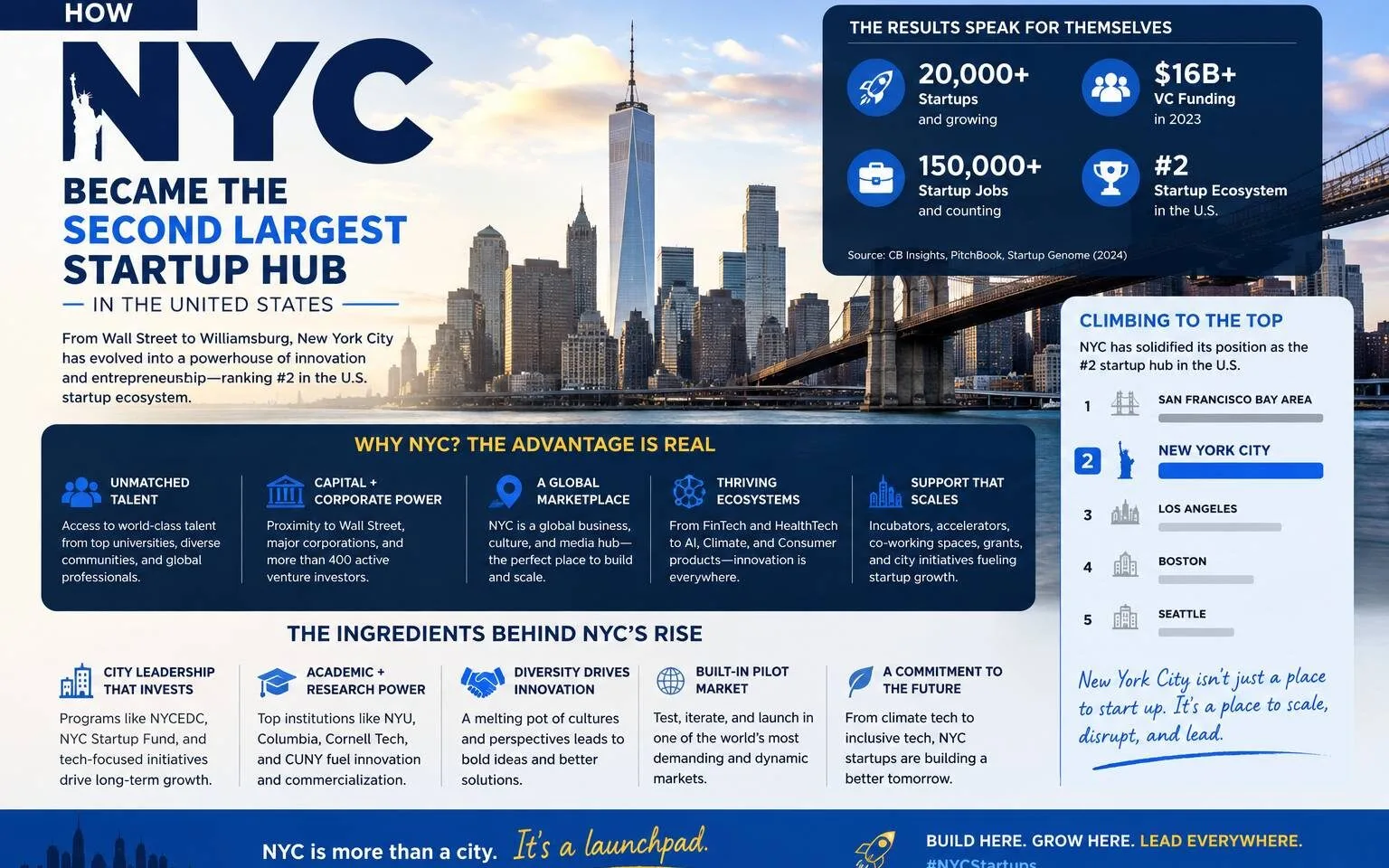
Today, New York City stands firmly as the second largest startup ecosystem in the United States, trailing only Silicon Valley, and the gap is closing faster than most people realize. With over 9,000 active startups, more than $30 billion in annual venture capital investment, and a talent pool fed by some of the world’s most prestigious universities, NYC has built something extraordinary over the past two decades. This is the story of how it happened and why it matters to everyone who calls this city home.
The Early Days: Wall Street Genes Meet Silicon Ambitions
New York has always been a city of dealmakers. Long before anyone used the word “startup,” NYC was the financial capital of the world, and that DNA turned out to be one of the most important ingredients in building a tech ecosystem. When the dot-com boom hit in the late 1990s, New York was not a passive observer. Dozens of early internet companies launched right here, from DoubleClick to Kozmo to iVillage.
The dot-com bust of 2000 and 2001 hurt, but it also did something valuable: it weeded out the ideas that were never going to work and left behind a core group of founders, engineers, and investors who had survived the storm and learned hard lessons about building real businesses with real revenue. That grit, which is frankly a New York trait more than a tech trait, became foundational to everything that came next.
By the mid-2000s, something was clearly stirring. The neighborhood now known as Silicon Alley, stretching from Flatiron down through the Village and into SoHo, started attracting a new generation of founders who were just as comfortable pitching a VC at a coffee shop as they were negotiating a term sheet at a midtown law firm.
Silicon Alley: New York’s Answer to the Valley
The term “Silicon Alley” was originally coined in the 1990s to describe the cluster of internet companies around the Flatiron District and lower Manhattan, but its meaning has expanded dramatically. Today, Silicon Alley is less a geographic description and more a state of mind. It represents an entire philosophy of building tech companies that are rooted in New York’s core industries rather than transplanting Bay Area culture wholesale.
What makes Silicon Alley distinct is its verticality. While Silicon Valley often builds horizontal platforms designed to work across every industry, New York’s startups tend to go deep into specific sectors where the city already has massive existing expertise: finance, media, fashion, real estate, healthcare, and advertising. This is not a limitation. It is a strategic advantage that has produced some of the most defensible and valuable companies in the country.
When a fintech startup is founded in New York, it is not just near Wall Street, it is inside Wall Street’s ecosystem of talent, clients, regulatory knowledge, and institutional relationships. When a media startup launches in Manhattan, it has immediate access to the editors, brands, and advertising agencies that power the global content industry. That proximity to customers and domain experts is something no amount of Palo Alto sunshine can replicate.
The Turning Point: 2010 to 2015
If there was a single period that cemented New York’s position as a world-class startup hub, it was the early 2010s. Several forces converged at exactly the right moment.
Mayor Bloomberg’s Big Bet on Tech
In 2011, Mayor Michael Bloomberg made one of the most consequential decisions in the city’s modern economic history. The city launched a competition inviting universities from around the world to build a new applied sciences and engineering campus in New York City. Cornell University and Technion-Israel Institute of Technology won the bid, and Cornell Tech was born on Roosevelt Island.
The $2 billion campus, which opened its first permanent buildings in 2017, was explicitly designed to bridge the gap between academic research and commercial application. It graduates hundreds of engineers, computer scientists, and product managers every year, many of whom choose to stay in the city and join or found startups. For New Yorkers, this was the city putting real money and real land behind its ambitions to compete with MIT and Stanford’s influence on Silicon Valley.
Bloomberg also invested heavily in the city’s Applied Sciences NYC initiative, supported the growth of coding education programs, and used the bully pulpit of the mayor’s office to recruit technology companies aggressively. When he famously made a New Year’s resolution to learn to code in 2012, it was corny, but it signaled something real: city hall was paying attention to tech in a way it never had before.
The Rise of the Accelerator and Co-Working Scene
The early 2010s also saw the explosion of startup support infrastructure in the city. General Assembly launched in 2011 in the Flatiron District and quickly became a hub for coding bootcamps, tech education, and community events that connected founders with talent. WeWork, founded in New York in 2010, built co-working spaces that became defacto startup campuses, lowering the cost and friction of getting a company off the ground in one of the world’s most expensive real estate markets.
Accelerator programs proliferated. Y Combinator started accepting more New York-based companies. Techstars NYC launched and began producing a steady stream of funded startups. ERA (Entrepreneurs Roundtable Accelerator) focused specifically on the New York ecosystem and helped dozens of companies through their earliest stages.
Iconic Companies Put NYC on the Startup Map
Nothing attracts founders and investors to a city like a highly visible success story. Between 2010 and 2015, New York produced a string of breakout companies that made the whole country take notice.
- Tumblr sold to Yahoo for $1.1 billion in 2013, one of the first major tech exits out of the New York ecosystem at that scale.
- Etsy, founded in Brooklyn in 2005, went public in 2015 in a highly anticipated IPO that celebrated a homegrown NYC success story.
- Foursquare became a global phenomenon and one of the defining apps of the early smartphone era, born right here in Manhattan.
- BuzzFeed, founded in New York, redefined digital media and raised hundreds of millions in venture capital.
- MongoDB, headquartered in NYC, became one of the most important database companies of the cloud era.
These were not flukes. They were proof points that New York could produce venture-scale tech companies across multiple categories, and they sent a powerful signal to the next generation of founders: you do not have to move to California to build something big.
The Industries Where New York Startup Dominates
Understanding why New York is such a powerful startup ecosystem requires understanding where New York startups are actually winning. Unlike Silicon Valley, which tends to concentrate heavily in enterprise software, consumer apps, and semiconductors, New York’s startup scene is more diversified and industry-specific.
Fintech: Disrupting the Industry Next Door
New York is the undisputed capital of American finance, and that proximity has made it the natural birthplace for fintech. The city is home to an extraordinary concentration of fintech companies that have built everything from payment infrastructure to robo-advisors to insurance technology.
Oscar Health, founded in New York in 2012, reimagined health insurance for the tech era and went public in 2021. Betterment pioneered the robo-advisory space and manages tens of billions in assets. Brex, while founded by Brazilian founders, chose New York as its operational home. Ramp, the corporate card and spend management platform, is a New York fintech unicorn that has grown explosively.
The reason New York consistently produces great fintech companies is simple: when your founders, engineers, and early customers all work within a few subway stops of Goldman Sachs, JPMorgan, and Citigroup, you develop an intimate understanding of what the financial industry actually needs, what it will pay for, and how to sell to it. That knowledge advantage is nearly impossible to replicate elsewhere.
Media and AdTech: Built for the Content Capital
New York has been the center of the American media industry for well over a century, and that legacy has translated directly into a thriving ecosystem of media-focused startups and advertising technology companies. The city is home to the headquarters of virtually every major American media company, which means there is a constant demand for technology that helps content get created, distributed, monetized, and measured.
Companies like Taboola, DoubleVerify, and Integral Ad Science have built billion-dollar businesses in the advertising technology space, all out of New York. The Daily Beast, Vox Media, The Athletic, and dozens of other digital media companies chose New York as their home base because that is where the talent, the brands, and the advertising dollars are concentrated.
E-Commerce and Fashion Tech
New York’s fashion industry, centered in the Garment District and showrooms scattered across Midtown and SoHo, has spawned a unique cluster of e-commerce and retail technology startups. Warby Parker, founded in New York in 2010, pioneered the direct-to-consumer eyewear model and became a blueprint for an entire generation of DTC brands. Rent the Runway invented the fashion rental market. Birchbox pioneered the subscription beauty box category.
The logic here is the same as in fintech: when you are surrounded by the people who actually run fashion brands, department stores, and luxury retail operations, you build products that solve real problems for real customers, not hypothetical ones.
Real Estate Tech (PropTech)
No city in the world has a more complex, contentious, and economically significant real estate market than New York. It should surprise no one, then, that the city has become the global center of real estate technology innovation. StreetEasy, the dominant apartment search platform for New York renters and buyers, was acquired by Zillow for $50 million but started as a pure New York play. Compass, the technology-powered real estate brokerage, was founded in New York and grew to become one of the country’s largest residential real estate companies. VTS, which builds commercial real estate leasing and asset management software, operates out of Manhattan and counts most of the world’s largest landlords as clients.
Healthcare and Life Sciences
New York is home to some of the world’s leading hospitals and medical research institutions, including NewYork-Presbyterian, Memorial Sloan Kettering, Mount Sinai, and NYU Langone. This concentration of clinical expertise and medical research has fueled a rapidly growing health tech and life sciences startup scene, with companies working on everything from telehealth platforms to genomic medicine to AI-powered diagnostic tools.
Flatiron Health, which built an oncology-focused data platform, was acquired by Roche for $1.9 billion and is perhaps the defining example of a New York health tech success story. Ro, the direct-to-consumer telehealth company, has grown into a multi-billion-dollar business. Oscar Health continues to push the boundaries of what technology can do to improve health insurance outcomes.
The Money: Venture Capital in New York City
Great startup ecosystems require great investors, and New York has built one of the deepest venture capital communities in the world. For years, the conventional wisdom was that serious tech investors lived in Menlo Park and Sand Hill Road, and that New York startups had to fly to California to raise serious money. That is simply no longer true.
New York is now home to the offices of virtually every major venture capital firm in the world, including Andreessen Horowitz, Sequoia Capital, Benchmark, and Founders Fund. But beyond the Valley transplants, the city has developed its own world-class native VC ecosystem.
Union Square Ventures, founded in New York in 2003 by Fred Wilson and Brad Burnham, was one of the most influential early-stage investors in the country and backed Etsy, Twitter, Tumblr, and Foursquare, among many others. Thrive Capital, run by Joshua Kushner, has become one of the most respected growth-stage funds in the country. Insight Partners, headquartered in midtown Manhattan, manages over $90 billion in assets and has backed hundreds of software companies globally. FirstMark Capital, RRE Ventures, Lerer Hippeau, and Primary Venture Partners have all built strong track records investing specifically in New York companies.
The result is that a founder in New York City today can raise a pre-seed round, a Series A, a Series B, and a growth round without ever leaving the five boroughs, if they want to. The capital that used to require a transcontinental flight is now available in the same building, or at the coffee shop around the corner.
The Talent Pipeline: Why the Best Want to Work Here
Startups are only as good as the people who build them, and New York’s talent pipeline is arguably the most diverse and accomplished of any city in the country. The reasons come down to a combination of education, immigration, and simple magnetism.
World-Class Universities, Right Here
New York City is home to or in close proximity to an extraordinary concentration of research universities and professional schools. Columbia University, New York University, Cornell Tech, The New School, Fordham University, Baruch College, and Brooklyn College collectively produce tens of thousands of graduates every year across engineering, business, computer science, design, and dozens of other disciplines relevant to the startup economy.
Unlike Silicon Valley, which draws its university talent pipeline primarily from Stanford and UC Berkeley, New York’s talent pool is far more heterogeneous. You have world-class engineers from Columbia working alongside business strategists from NYU Stern and designers from Parsons, and they are all choosing to stay in the city after graduation because, well, it is New York.
A City That Attracts the World’s Best
New York has always been a city of immigrants, and that identity has become one of its greatest economic assets in the startup era. The city’s diversity attracts international talent at a scale that few other American cities can match, and international founders and engineers have been responsible for a disproportionate share of the city’s most successful startups.
The cultural appeal of New York, its arts scene, its food, its neighborhoods, its sheer density of interesting people and experiences, makes it possible to recruit talent that might otherwise be lured by the higher base salaries and stock options available in the Bay Area. Many of the most sought-after engineers and product managers choose New York specifically because they want to live in New York, and that preference gives startups here a meaningful recruiting advantage over remote-first companies or those based in less dynamic cities.
Cross-Industry Talent Flows
One of the most underrated features of the New York talent market is the richness of cross-industry career movement. A marketing executive who spent a decade at Condé Nast brings a media industry perspective that no amount of generalist startup experience can replicate. A risk manager from Goldman Sachs who joins a fintech startup brings regulatory knowledge and client relationships that are extraordinarily difficult to acquire any other way. A supply chain manager from a major fashion retailer who co-founds a fashion tech company understands the customer’s actual problem in granular detail.
This cross-pollination of domain expertise is one of the defining characteristics of the New York startup ecosystem, and it consistently produces companies with a more sophisticated understanding of their target markets than comparable startups founded by teams with purely technical backgrounds.
The Neighborhoods: Where Startup New York Lives
For those of you who live here, the geography of New York’s startup ecosystem is familiar, but it is worth mapping explicitly because the concentration of activity in certain neighborhoods has created powerful network effects that continue to attract new companies.
Flatiron District remains the spiritual heart of Silicon Alley. The blocks around 23rd Street and Broadway are home to an extraordinary density of tech companies, co-working spaces, accelerators, and the offices of major VC firms. If you work in tech in New York, you have probably had at least one meeting in the Flatiron District this month.
DUMBO (Down Under the Manhattan Bridge Overpass) in Brooklyn has emerged as one of the most vibrant startup neighborhoods in the country. With its mix of converted industrial buildings, creative agencies, tech companies, and easy access to Manhattan via the F and A trains or the East River Ferry, DUMBO has a distinct energy that appeals particularly to founders building consumer brands, creative technology companies, and e-commerce businesses. Etsy had its offices in DUMBO for years, and the neighborhood has continued to attract companies in its mold.
Hudson Yards has become a magnet for larger tech companies and fast-growing startups that have outgrown their Flatiron roots. The relative newness of the neighborhood and its modern office infrastructure have attracted a mix of established tech firms and well-capitalized scale-ups.
Midtown South, encompassing the area from 14th Street to 34th Street, functions as a kind of extended campus for the tech industry, with companies spread across a wide variety of office buildings and converted loft spaces. The concentration of transportation infrastructure in this zone, with subway lines running in every direction, makes it highly accessible for employees coming from all five boroughs and the broader metro area.
Lower Manhattan has seen significant growth in fintech and financial technology companies, benefiting from proximity to the legacy financial industry on Wall Street while offering comparatively lower rents than midtown or Flatiron.
Major Milestones: The Unicorns and Exits That Defined NYC Tech
The true measure of a startup ecosystem is the companies it produces, and by that measure, New York’s track record over the past fifteen years is remarkable. The following represents just a partial accounting of the exits, IPOs, and unicorn valuations that have made New York one of the most important technology centers in the world.
- Tumblr acquired by Yahoo for $1.1 billion (2013)
- Flatiron Health acquired by Roche for $1.9 billion (2018)
- Etsy IPO at over $1.8 billion valuation (2015), now a multi-billion dollar public company
- MongoDB IPO on NASDAQ (2017), now valued at over $10 billion
- Peloton IPO raising over $1.1 billion (2019)
- Oscar Health IPO at $7.9 billion valuation (2021)
- Compass IPO at $7 billion valuation (2021)
- DoubleVerify IPO raising $350 million (2021)
- Warby Parker direct listing at $6 billion valuation (2021)
- Rent the Runway IPO (2021)
- Ramp reached unicorn status at $8.1 billion valuation
- Brex valued at over $12 billion
These are not simply financial events. Each of these companies created hundreds or thousands of well-paying jobs in New York City, generated significant wealth for employees who stayed and built, and demonstrated to the next generation of founders that building a major company in New York is not only possible but increasingly common.
The Amazon HQ2 Effect: Losing the Battle, Winning Something Else
No chapter in the recent history of NYC’s tech ecosystem would be complete without addressing Amazon’s aborted HQ2 plans. In 2018, after a highly publicized national search, Amazon announced it would split its second headquarters between Northern Virginia and Long Island City, Queens. The New York announcement was greeted with enormous excitement by the business community, with promises of 25,000 high-paying jobs and a $2.5 billion investment.
Then, in early 2019, after a fierce political backlash led largely by incoming Council Member Alexandria Ocasio-Cortez and concerns about the $3 billion in tax incentives the city and state had offered, Amazon withdrew from the New York deal entirely.
The episode generated enormous controversy, and reasonable people disagreed strenuously about whether the outcome was good or bad for the city. But one of the underappreciated effects of the Amazon affair was what it revealed about the underlying strength of the New York tech ecosystem: it kept growing robustly without Amazon. The doomsayers who predicted that rejecting HQ2 would set New York’s tech ambitions back by a decade were simply wrong. The city’s startup ecosystem continued to attract capital, talent, and new companies at an accelerating pace in the years after Amazon’s departure.
The episode also sparked a broader conversation about what kind of tech economy New York actually wants: one built on attracting massive established companies with public subsidies, or one built on homegrown startups that develop organically from the city’s existing strengths. For many New Yorkers, the answer was clear.
COVID-19: The Test That Made NYC Stronger
The COVID-19 pandemic was the most severe stress test the New York startup ecosystem has ever faced. The city that was hit hardest and earliest in the United States, New York endured a period of devastating loss, economic disruption, and uncertainty about whether its density and its culture of in-person collaboration were now liabilities rather than assets.
Many predicted that the pandemic would permanently accelerate the departure of tech talent and companies to Miami, Austin, and other cities with lower costs and warmer climates. And there was truth in those predictions: some founders and employees did leave, and competing cities invested aggressively in attracting New York talent during the remote work window.
But the obituaries for New York tech turned out to be, as they so often do with this city, wildly premature. As the pandemic receded, the vast majority of the companies and talent that had left or gone remote chose to return or maintain significant New York presences. The city’s unique advantages, its deal flow, its industry connections, its cultural richness, its ability to attract global talent, did not disappear. They reasserted themselves.
The pandemic also accelerated certain trends that benefited New York startups disproportionately. The explosion in telehealth, digital commerce, fintech adoption, and remote work infrastructure created enormous opportunities for New York companies with existing expertise in healthcare, e-commerce, and financial technology. Companies like Ro, Etsy, and Ramp saw their growth trajectories supercharged by pandemic-era behavioral shifts.
The AI Wave: New York’s Next Chapter
The artificial intelligence revolution that has dominated the technology conversation since the launch of ChatGPT in late 2022 has opened a new and potentially transformative chapter for the New York startup ecosystem. While the foundational AI model companies like OpenAI and Anthropic are headquartered on the West Coast, the application layer of the AI economy, where the most value is likely to be created over the next decade, is being built everywhere, and New York is extremely well positioned to capture a large share of it.
New York’s strengths in fintech, healthcare, media, and real estate are all industries being radically disrupted by AI applications, and founders with deep domain expertise in those industries are building AI-native companies to take advantage. The city’s concentration of financial services professionals is generating a wave of fintech AI startups. Its healthcare institutions are spawning AI diagnostic and clinical workflow companies. Its media ecosystem is producing AI content and publishing tools.
New York is also home to world-class AI research at institutions including NYU’s Center for Data Science, Columbia’s Data Science Institute, and Cornell Tech, which are producing the PhDs and researchers who go on to found or lead AI companies. The city’s emerging AI ecosystem is being supported by a growing number of AI-focused investors and accelerators who see an opportunity to back the application layer of the AI revolution in the world’s most industry-diverse city.
Challenges: What New York Still Has to Solve
Any honest assessment of New York’s startup ecosystem has to acknowledge the real challenges that make building here harder than it needs to be. New Yorkers are famously unsentimental about their city’s flaws, so let us be direct.
Cost of Living and Office Space
New York is one of the most expensive cities in the world to live and work in. Recruiting engineers who can make the same salary in Austin or Denver and rent a three-bedroom house is genuinely difficult when those same dollars get you a studio apartment in Brooklyn. The cost of office space, while it has moderated since the pandemic, remains a significant burden for early-stage startups. These are real costs that show up in runway calculations, hiring decisions, and the ability to compete for talent with companies in lower-cost markets.
Technical Talent Density
Despite its many advantages, New York still lags behind Silicon Valley in the sheer density of software engineering talent. The Bay Area’s concentration of engineering talent, built up over decades around major tech companies and elite engineering programs, creates a hiring environment that New York has not fully replicated. This is improving steadily, particularly as Cornell Tech graduates more students and as tech-focused education programs proliferate, but it remains a gap.
Regulatory Environment
New York’s regulatory environment, while no worse than many comparable global cities, can be challenging for startups in regulated industries like fintech, healthcare, and real estate. The costs and complexity of navigating New York State and City regulations add friction that founders in less regulated markets do not face. This is particularly acute for startups trying to operate in multiple markets simultaneously, where New York’s regulatory requirements can be significantly more demanding than those of other states.
Government Bureaucracy
The city government’s relationship with the startup ecosystem has been uneven. While individual mayors have made tech a priority at various points, the institutional capacity of city government to consistently support, procure from, and collaborate with startups has lagged behind what the ecosystem needs. Procurement cycles that take years, pilot programs that never scale, and a regulatory framework designed for large incumbents rather than fast-moving startups are all real obstacles that the ecosystem continues to navigate.
What New York’s Startup Ecosystem Means for Regular New Yorkers
If you are a New Yorker who does not work in tech, you might be wondering what any of this actually means for your life. The answer is more than you might think.
The growth of New York’s startup ecosystem has been a significant driver of job creation and wage growth across the entire city economy. The technology sector now employs hundreds of thousands of New Yorkers, not just engineers and product managers, but office managers, legal professionals, accountants, HR specialists, marketers, designers, and dozens of other roles that are present in every growing company.
The tax revenues generated by successful tech companies and their highly compensated employees have contributed significantly to the city’s fiscal health, funding public services, schools, and infrastructure that benefit all New Yorkers. The startups themselves have often built products and services, in healthcare, housing, food delivery, transportation, and financial services, that have genuinely improved daily life for people across all five boroughs.
The growth of the tech economy has also contributed to the revitalization of neighborhoods like DUMBO, Long Island City, and the Flatiron District, bringing investment, new restaurants and amenities, and economic activity that has created opportunities beyond the tech sector itself.
None of this is to say the growth of the tech economy has been without costs or tensions. The relationship between rising tech salaries, real estate prices, and the displacement of lower-income communities is a real and serious issue that the city continues to grapple with. Building a startup ecosystem that is genuinely inclusive and that creates opportunity for all New Yorkers, not just those with the educational and professional credentials to participate directly, is an ongoing challenge and a moral imperative for everyone involved in the ecosystem.
Looking Ahead: The Next Decade of NYC Startups
The trajectory of New York’s startup ecosystem over the next decade will be shaped by several forces that are already in motion.
The artificial intelligence revolution will create opportunities for founders with deep domain expertise to build transformative companies in every industry where New York is strong. The city that has the world’s best concentration of financial services, healthcare, and media professionals is extraordinarily well positioned to build the AI applications that will transform those industries.
The continued maturation of the local VC ecosystem, with more experienced investors, more recycled founder capital, and more sophisticated support infrastructure, will make it easier and faster to go from idea to funded company than at any previous point in the city’s history.
The ongoing development of Cornell Tech and the expansion of computer science programs at NYU, Columbia, and the CUNY system will continue to improve the depth and diversity of technical talent available to startups.
And the city itself, its energy, its diversity, its density of industries and ideas, will continue to function as the most powerful recruiting tool in the ecosystem’s arsenal. The best people in the world want to live in New York City. That simple fact is, and will remain, the foundation of everything the startup ecosystem has built and everything it will build next.
Conclusion: This Is Your Ecosystem
New York’s rise to become the second largest startup hub in the United States is not a story that happened to New Yorkers. It is a story that was built by New Yorkers: by the founders who bet on this city when everyone told them to move to California, by the investors who believed in the unique advantages of building here, by the engineers and designers and operators who chose Brooklyn over the Bay Area, by the policymakers who invested in education and infrastructure, and by the domain experts from finance, healthcare, media, and fashion who brought their knowledge out of legacy industries and into the startup economy.
If you live in this city, this ecosystem belongs to you. Whether you are a first-generation immigrant working in the Bronx who is thinking about your first startup, a recent graduate from CUNY trying to break into tech, a seasoned finance professional considering a pivot to fintech, or a founder who just closed your Series A, you are part of the most dynamic, diverse, and resilient startup ecosystem outside of Silicon Valley.
New York has always done things its own way. The city did not become the second largest startup hub in the country by copying Silicon Valley. It did it by being relentlessly, unapologetically itself. And if the past two decades are any indication, the best chapters of this story are still ahead.